For the Birds

The heat is on—outside and sometimes in. A call to repair my swamp cooler (because water was pouring off the roof) eventually brought a repairman. He showed me a photo of a series of holes in a tube from which water was spraying. He blamed it on birds seeking water.

Note to Self: Refill the bird water dishes every day. I have two, but sometimes they go dry. I’m sure the birds would prefer an open source to having to prospect for their drinks.

A neighbor stopped to chat as I was preparing to water some bushes edging the lawn. She asked if I liked peaches. Who doesn’t? She had bought some expensive bird food, and then discovered that the birds around her fruit trees increased exponentially, so she had resorted to netting her peaches, only to find a Cooper’s hawk trapped in it.

The hawks at the park have produced a fine pair of fledglings this year. A few days ago, I watched them tussling in the street. 

This morning walking Sophie, I could hear their high pitched piping in a tree a block from the park. We stood beneath it and I looked up. One of the birds still showed bits of down, but when I aimed my phone at them they took off—so no pictures.

When Sophie and I reached the park, I spotted feathers in the grass. Hmm. Did the hawks have pigeon or dove for supper last night? If I was reading the fledgling’s cries correctly, they hadn’t had breakfast yet.

And yes, those peaches were delicious. As are the tiny plums she gave me. 

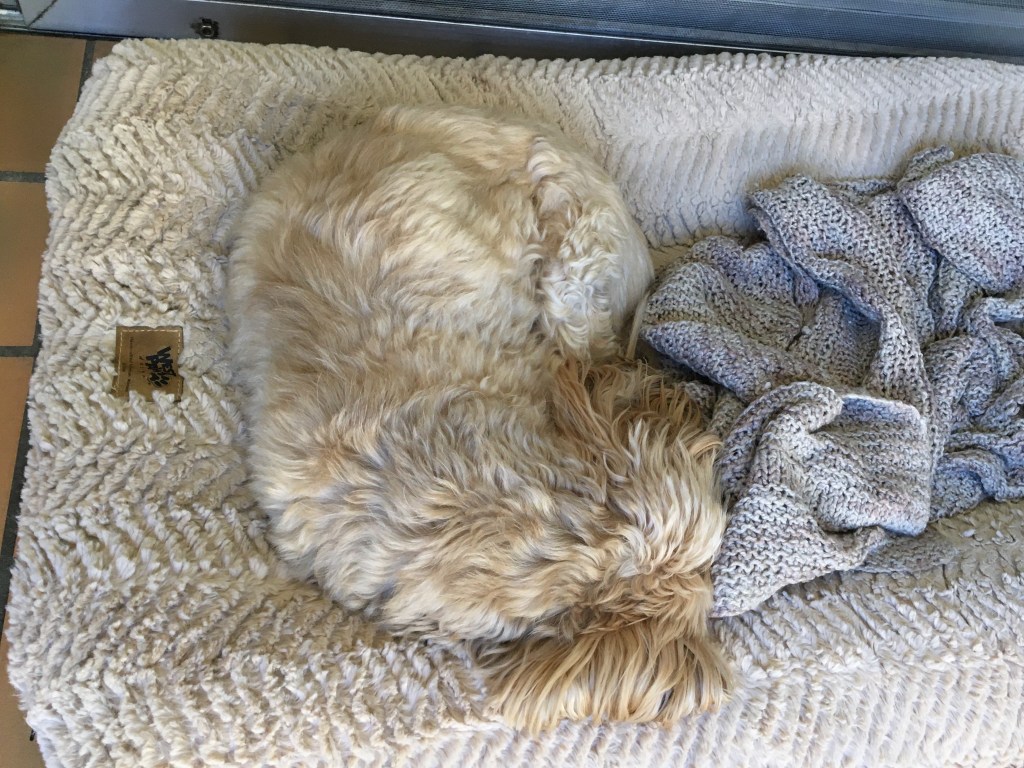
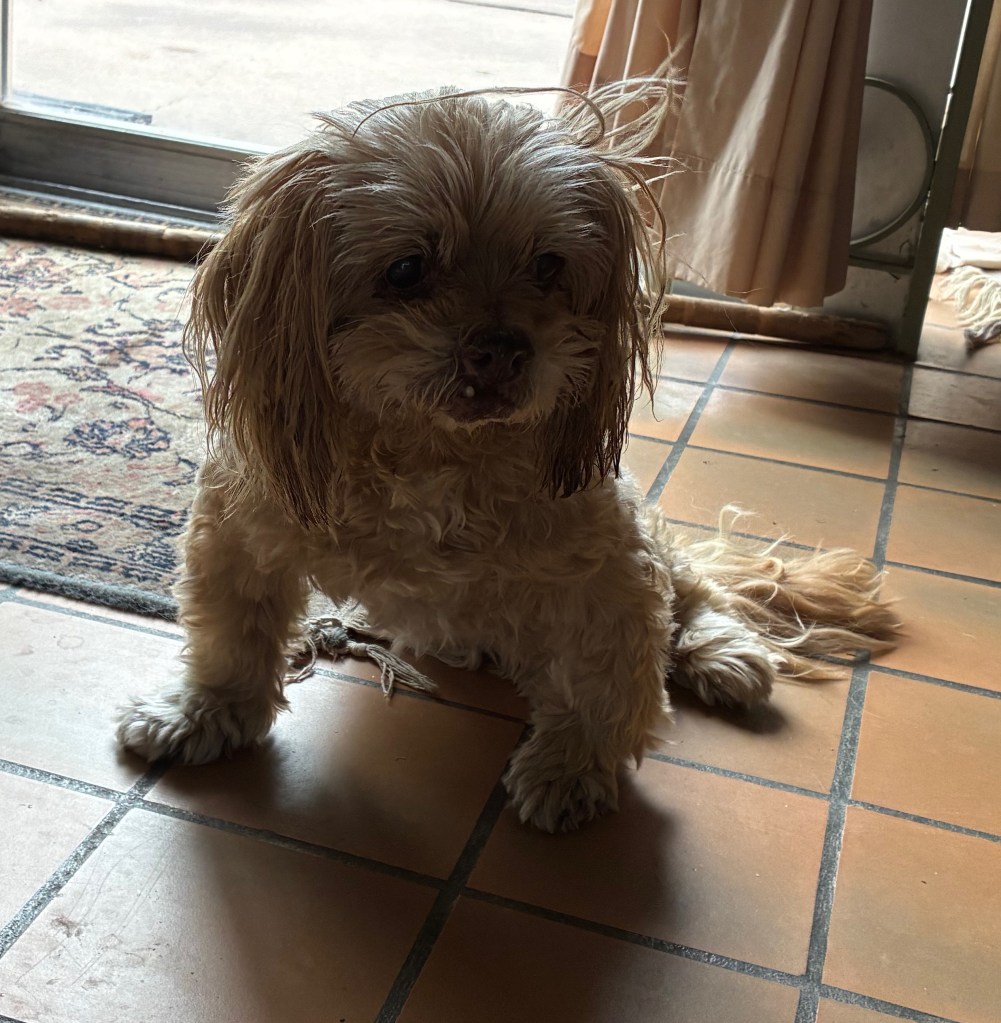
Here’s Miss Sophie in her SophieMobile. She gets to avoid hot streets in the evening, and I get to walk a lot faster, till we get to the shady park.

We’re still wrestling with her digestive issues. Just finished another vet visit.

A Day in the Life . . .

I seem to have taken a long sabbatical from blogging. And, I noticed that I was eating for no-good-reason and also exercising less, ditto. It occurred to me that maybe the eating was to replace the writing I wasn’t doing, and that I need to get back into a weekly rhythm of blogging, which requires an introspection of the mind, rather than a stuffing of the body.

Recently on NPR, Scott Detrow interviewed Kenn Adams, a playwright, who has developed an 8-sentence narrative device he calls Story Spine. So, how about if we start that way:

  1. Once upon a time there was a woman who lived contentedly with her wonderful husband and their loving dog.
  2. Everyday, her husband prepared the dog meals and they divided the dog walks between them; and, as he slipped deeper and deeper into dementia, he maintained those daily rhythms.
  3. But one day, he took the dog for a walk and didn’t come home.
  4. Suddenly, the whole neighborhood and the police were looking for him, until hours later she got a call saying the two had been found.
  5. Because of that, she took charge of his meds, saw to it that he took them on time, and monitored his movements more closely.
  6. Because of that, she took on more and more of the daily duties.
  7. Until finally, he stopped eating and told her that he was ready — no, that he insisted (with a thump of his fist to his knee) on dying and within a few days he was gone.
  8. And ever since then she has lived with both a sorrow and a great gratitude for having had 34 years of contentment with such a wonderful man.

Two years later

  1. Once upon a time, a woman had a small dog, the last living (aside from friends) remnant of her life with her husband, dead these two years and four months.
  2. Every day, she fed and walked the sweet dog who rewarded her by staying close and by sleeping beside her at night.
  3. But one day, the dog got diarrhea and was taken to the vet for treatment; but a change of diet with added probiotics and psyllium fiber didn’t seem to help.
  4. Suddenly, the dog stopped eating.
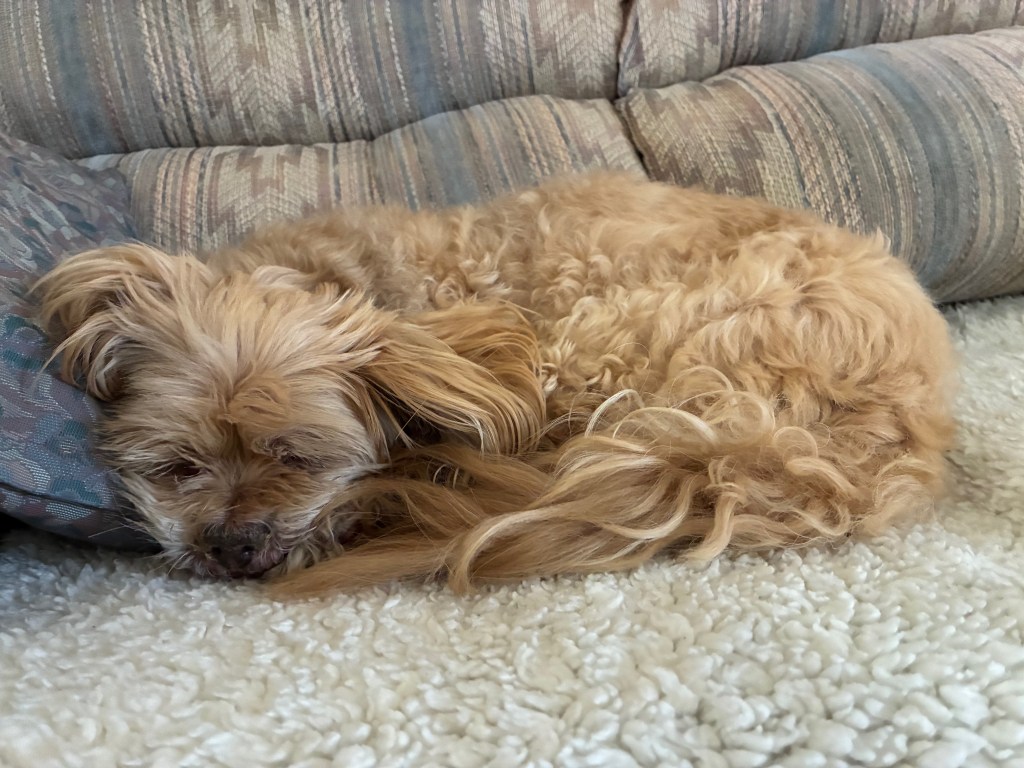
Never enough sofa time for a sick Sophie.

With Sophie’s refusal to eat, I experienced PTSD. A deep sense of grief washed through me.  Been there, done that—but was this the same as before? After waiting to hear from the vet, I called them again. This time we got an appointment for emergency care. 

All Sophie’s vitals checked out. She was treated for nausea, received hydration, and is back home with an antibiotic. 

So not this time, no new loss. Sophie is going to get better.

On Weeding: Plants and Lives

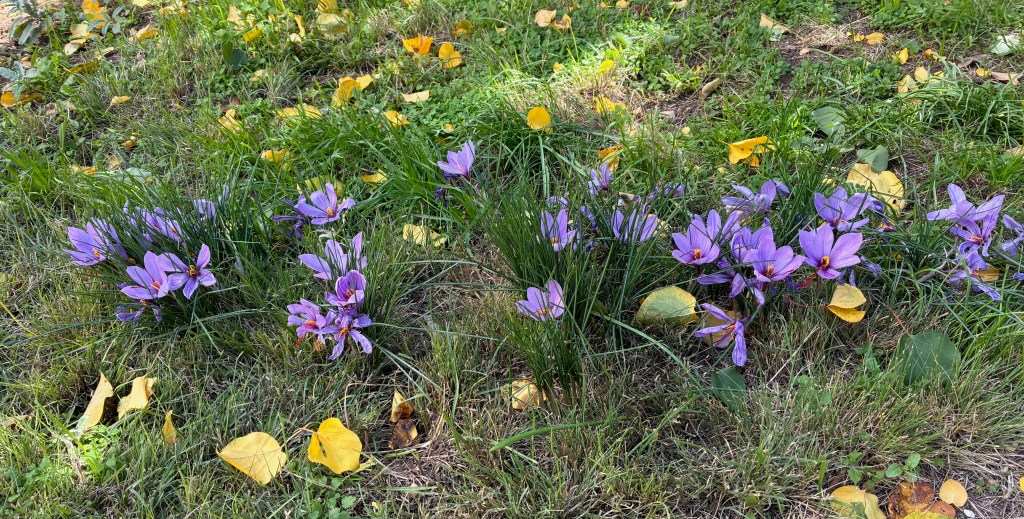
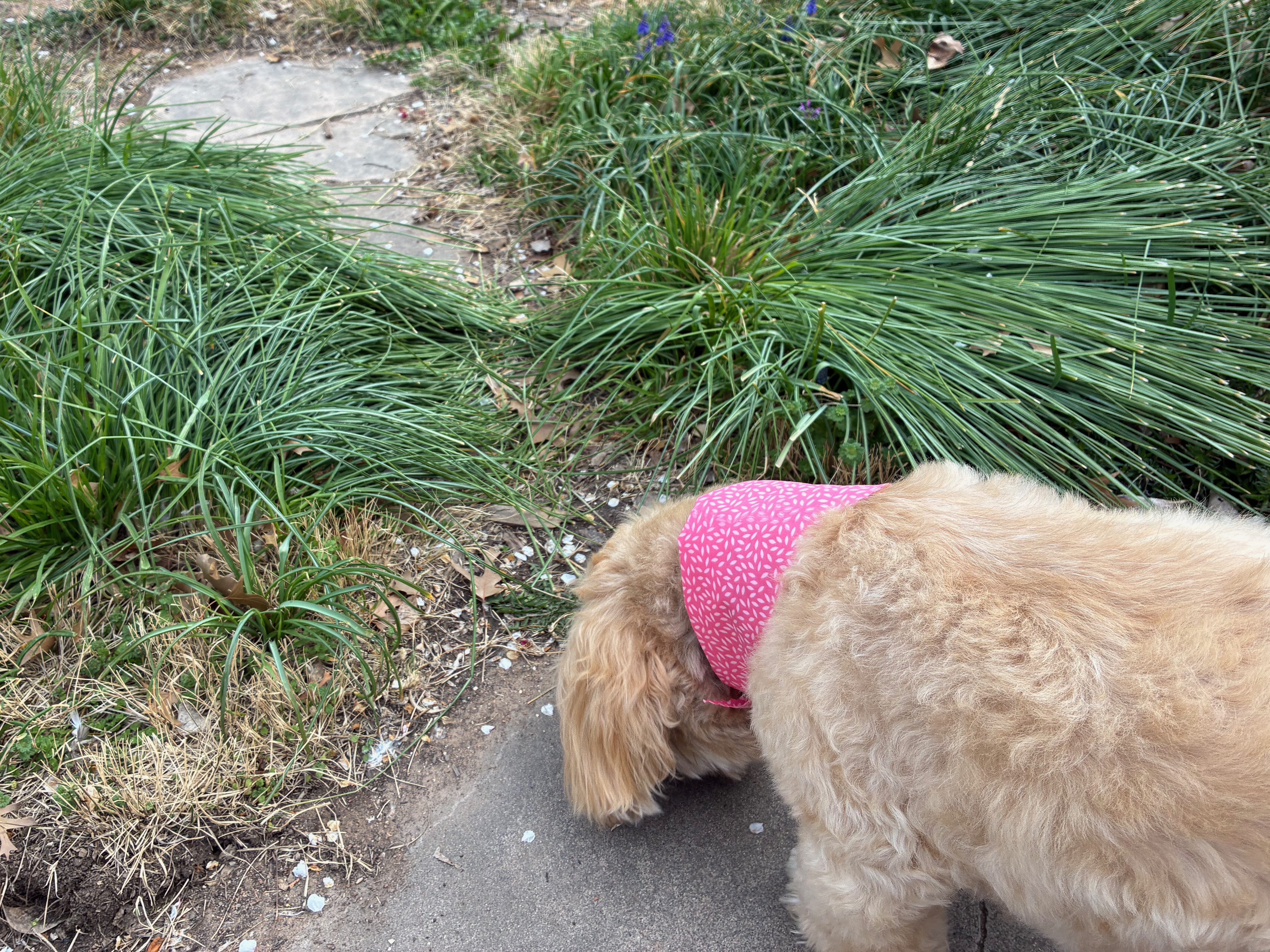
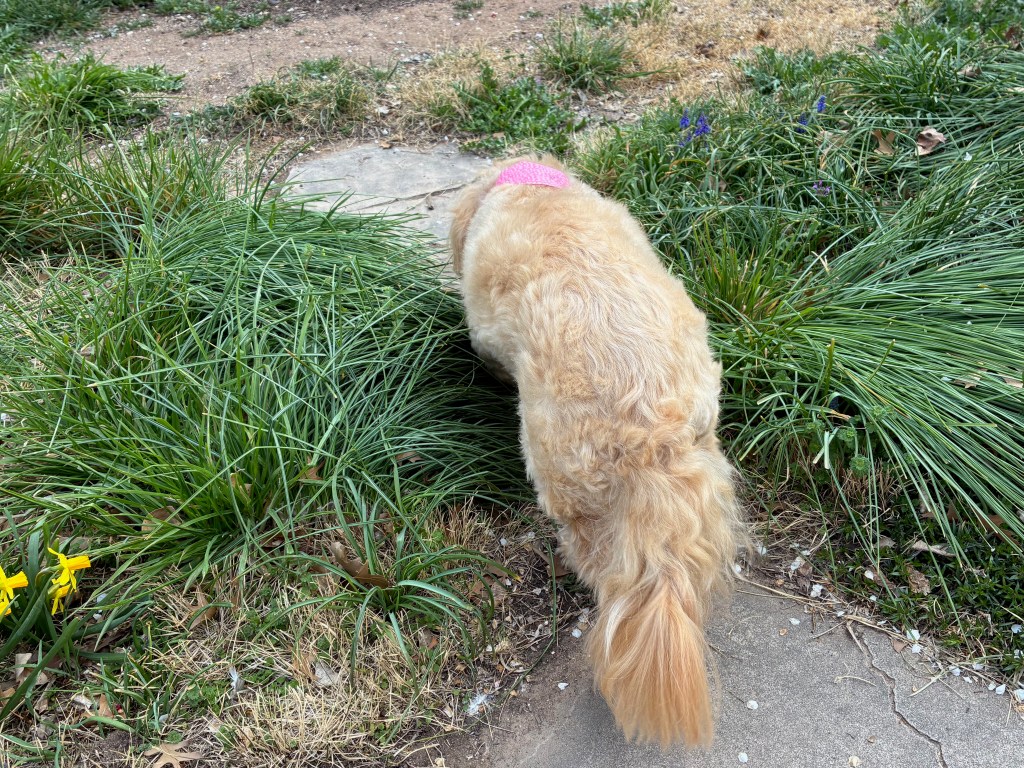
On weeding plants. Our strange winter—mostly warm with lots of early moisture—has left Sophie with a dilemma of how to pass through the barrier to the walkway in our backyard where she goes to do her business. Actually, that particular barrier is the over-grown fall crocuses from which I harvested their saffron last year. Such giving plants, I thought, deserved to not be mowed down.

But when Sophie looks for alternate routes, she discovers weeds, lots of them, especially large wild mustard plants.

I will say one good thing about Daylight Savings Time—and I absolutely hate those bi-yearly clock switches—is that I find time and daylight after supper to go outside to weed. I hope to seed part of the cleared area with a flower mix, which needs to be scattered right now. It’s hurry up and clear the ground time.

On weeding lives. Actually the life needing to be weeded is singular—my own—though my intrusive weeds are multiple. I’m not going to list them, thank you very much. Their nature is to fill in any space where there’s a vacancy.  In my case, this means escaping into books and dvds. Anything to not think or feel.

I recommend having a therapist to help work through the mess grief makes of one’s life. I’m very good at shoving feelings deep down; those burials leave a kind of emptiness which therapy helps refill.

Another source of help came when I accepted a challenge to write morning pages for two weeks. Filling both sides of a sheet of paper has served as a kind of meditation, recording a jumble of thoughts. 

This week, I sat in a sunny spot scribbling away. It occurred to me that the little nook I was in would be an ideal setting for my drop-leaf desk, which then stood in a dark, chilly corner. In the sun, I might be much more inclined to actually put it to use.

That idea came so alive that I started in immediately. Two sets of shelves have been emptied, scrubbed, and relocated to make room for the also emptied and scrubbed desk. Years of thinking about downsizing turned into action with this little move.The detritus—items I’m not putting back on the shelves or into the desk—remain to be sorted and redistributed.

Inside and outside weeding. Sigh. Well, both labors are a beginning.

How about you? What kind of clearing out have you been putting off?

Bouncing from book to book

I apologize for my long silence. As my therapist tells me—I’ve never been  here before; never been widowed—two years today. Sometimes I bury myself in fiction (especially familiar stories) rather than ponder indecision and unanswered questions such as Where do I go from here?

So, where thoughts and books are concerned, it came as a pleasant surprise to discover energy in exploring and pondering topics found in not one but four non-fiction books simultaneously.

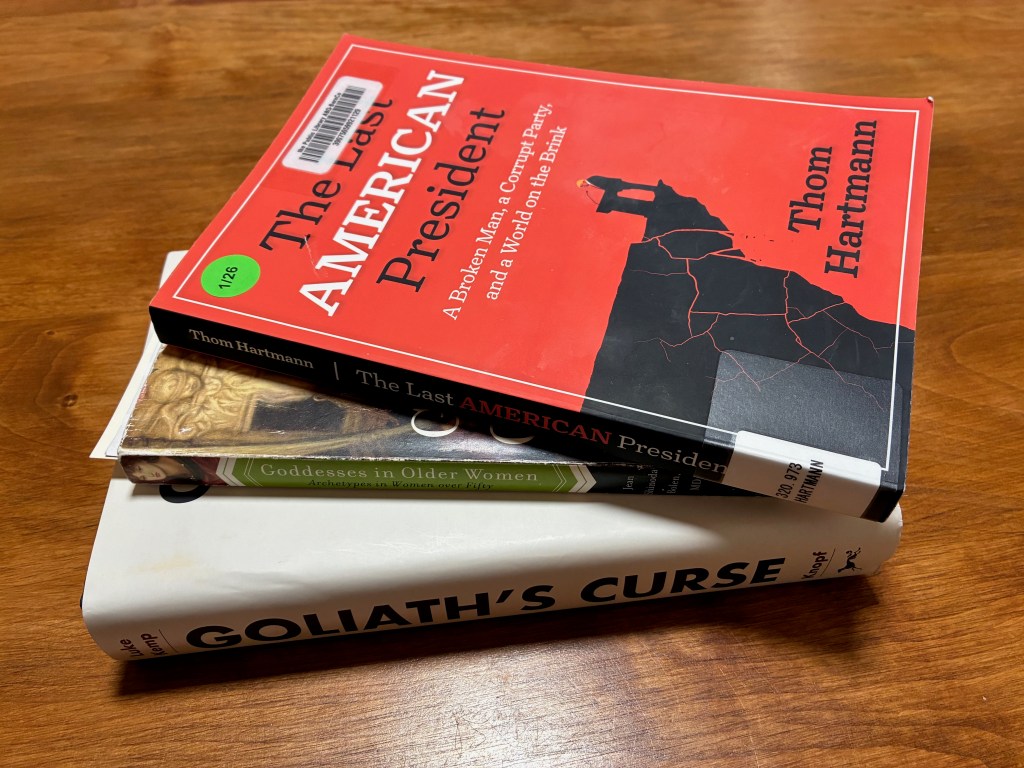
The first showed up in the library box at my neighborhood park. Goddesses in Older Women; Archetypes in Women over Fifty,by Jean Shinoda Bolen, MD. 2001, which highlights the wisdom and understanding gained over the years that now can enrich our lives. The book reminds me of my readings on goddess religions decades ago, which inspired the backgrounds of my as-yet-unpublished fairytale retellings.

Then there’s a title mentioned by a friend. I began reading a library copy and ended up purchasing my own, which fully intend to return to reading soon. Goliath’s Curse; The History and Future of Societal Collapse, by Luke Kemp, 2025, explores, as far back as the Stone Age, the rise and fall of societies. The more we are on an equal footing with each other, the longer our societies last. The curse in the title relates to the accumulation of goods by a few. Beginning in agricultural times, certain crops lent themselves to storage and plunder. Societies, watch out!

The only book I’ve completely read (and returned to the library) was for a class on climate change. Bill McKibben’s Here Comes the Sun, 2025. Though McKibben doesn’t ignore the problems in store, he writes glowingly of where we’re headed, but—like the top dogs in Goliath’s Curse—today’s holders of petrochemicals are fighting hard to retain their “wealth” in the face of solar and wind energy freely available worldwide. We really have a lot of work to do in a very short window of time!

And finally, from the public library’s new book shelf, I grabbed up The Last American President; A Broken Man, a Corrupt Party, and a World on the Brink, by Thom Hartman. It makes for grim reading, as he details the many decades long course of actions that has brought our country to the extreme wealth-gap of today.

I need to get back to reading. What happens when societies collapse? How are we to get past this tug of war between renewable energies and petrochemical oligarchs? And how will we tackle the long struggle ahead?

***

Fifty years ago, a brain child of mine appeared with the picture of a teenager standing on a strange planet. Over the years, that vision has grown to a saga, the Pawn Quest trilogy plus one. The final volume is currently in the hands of a copyeditor. I mention it because its conclusion is dependent on the cooperation of teens and adults and even former adversaries. 

We’re all in this together.

Out of Step

I was raking leaves yesterday. Our fall leaf pickup was a month ago. That’s when I put out the apricot leaves—but my oak trees don’t pay attention to timetables. They are out of step.

Along with my oaks, I too have felt out of step, especially during these last few months. 

I lunched with a friend a couple days ago and told her how I spent my time escaping into DVDs and books—and she was totally supportive. But it would have been much better if I too had thought what I was doing was great, rather than sitting in judgment on my inability to write. I’m only now admitting that the events of the last two years have created a burnout of my creative juices.

So, being out of step, I want to figure out how to get back into step with myself. It turns out, I have already begun.

For years, I’ve operated on the principle that New Year’s Eve is a good time to bring some projects to a close. And it is also a good time to begin a new project before the start of the new year.

Akin to the job of raking leaves is the clearing out of old paper and epaper: years of Christmas cards; emails; filing cabinets of ephemera; journals . . .

The journals alone will take a long time—years, really. But I might succeed with some sorting tasks. For instance, my filing cabinets might be reorganized within the next twelve months.

This reorganizing challenge  will eventually be interrupted when the copyedits of Quantum Quest return to me, to be followed by preparing the book for publication and promotion. For that I’ll need all the creative energy I can muster.

So here’s my resolution for 2026. I will seek to regain my footing by sorting, discarding, reorganizing old matters. Hopefully, my outlook will then be ready for new challenges. And now back to raking leaves. 

Let me wish you all a Productive New Year.

Where would you like to begin?

A Bumpy Ride through the holidays

Some of us have it easy.

For weeks, dreading this holiday season, I’ve watched myself escape into anything other than the present. Consequently, with these special days looming, I worried about my ability to take care of what needed to be done.

In the immediate past (like two weeks), I’ve started most days with five minutes of meditation. The idea is to keep myself present—at least, present to whatever duty requires my presence. No way am I going to totally disavow escapism as a way of life, since it’s been a part of me, lo these many years.

Sunday’s weekly brunch for my sons came together as planned.

Monday, I feared missing out on my swim session without repeated reminders. Instead, I told myself all would be well, that I would remember, thus freeing my mind to really pitch into what had to be done.

What an amazing day Monday turned out to be. I had two boxes to send, probably on Tuesday. But before completing my daughter’s package, I had to finish a project begun weeks ago, then set aside. A good thing I’d eaten a large breakfast. I went to work.

The project was revised, printed out, and packed—in fact, both boxes were packed and sealed—with still time to swim before the pool closed. Immediately following my swim, I stood in line at the post office to mail the packages, drove to the credit union to take care of three matters, on to the library to drop off three books and pick up one hold, and finally back home to a mid-afternoon lunch. 

Yay, me! I took the rest of the day off.

Most of Tuesday was spent avoiding the idea of tackling Christmas cards, but in the evening, I completed the first two. It would be more time-efficient to write a general letter to insert in each, but since I couldn’t bring myself to do that this year, each letter is getting its own handwritten note.

This morning has been devoted to more cards. And finally, to write up this blog. The lesson is: We can do what we must.

Holidays are good

Deadlines are invaluable.

So, how about that little matter of Global Warming? 

Second Year Blues

The long shadows of winter’s approach

I’ve always been rather low-key when dealing with holidays. For instance, in the winter, I prefer the soft warm glow of a Christmas Eve luminaria display over a month of electric glare.

But I didn’t expect the whammy that this year brought—even before Thanksgiving. Last year, my loss was fresh, still front-and-center in my attention. And I was in a grief group. We had few expectations beyond acknowledging the holes in our lives, and any rituals we wanted to incorporate.

In this second year, my attention has moved outward—somewhat. I took two trips. I worked on the opus. I contemplated the future. 

And then (as noted in my previous blog), my manuscript went to a copyeditor. My last anchor was gone. Ignoring other projects I went AWOL. Why?

Something was nagging at me that I didn’t want to pay attention to. 

Two years ago, Wayne was visibly declining during our last Thanksgiving and our last Christmas. The coming holidays loomed. It took weeks to recognize that by escape reading and DVDs, I had cut out everything but meals, dog care, and any unwelcome demands on my calendar. 

Mention of an early Friday morning meditation group caught my ear. My mind went ping! and I set an intention to join them. 

Experts all agree that meditation is healthy. That doesn’t mean it’s easy. That’s why I prefer sitting in a group, where expectations hold me in place. After fifty minutes of silence (in two 25 minute segments), I felt awake, alert, ready to face the day’s needs. 

Since then, I’ve taken a few minutes to sit in silence each morning, feet anchored on the floor, back straight, while I tell myself to be mindful during the day. Five minutes fly past, and I get up to do my PT.

It is what it is.

Understand—it’s not comfortable paying attention to old sorrows—but if I willingly enter into my feelings, they fade. They’ll return again, but experiencing those waves of sadness are preferable to shutting out the whole world just to avoid them. I need people and grounding in reality.

We’re not all alike. There are many kinds of avoidance. For instance, the hero of my sci fi novels throws himself into work. I will always enjoy escaping into fictional worlds, but within limits. I don’t need to do so at an addiction level.

How do you handle your losses and grief? 

After a Long Silence

It has been a beautiful fall, with trees holding their leaves. We had several near or at freezing nights and finally, yesterday morning, a harder freeze. True to their nature, the mulberry trees began their drip drip drip of big leaves piling up beneath trees and on nearby sidewalks. Walking Sophie, I had to lead the way, kicking leaves aside for my small plodder.

I too have been waiting—not for a freeze but for change from feeling frozen in time and space. I haven’t blogged in six weeks and at first couldn’t understand why. Still don’t, actually. It’s all theory.

I was working hard to bring my manuscript to a sense of completion before sending it off to my new copyeditor, but even before that, I felt its loss. Fifty years ago—as my daughter crawled around—I typed up an idea featuring a boy standing on a strange planet. That idea has kept me company over the years as I explored my characters’ world: ((Pawn Quest, Ty’s Choice), and what happened when they arrived on that planet: (Planet Quest). 

Finally, finally, we’re nearing the end: (Quantum Quest).

Letting Go is Hard!

In bringing my heroes’ journey to a close, it never occurred to me that I’d experience this sense of loss, this great hole. There will still be additions, amendments, and the slog of preparing to book for publication, but this pause is a harbinger of the future.

Unable to bring myself to blog or tackle other projects, I turned to watching DVD murder mysteries and reading book trilogies.

Pari Thomson’s three Greenwild books begin with The World Behind the Door. Along with Daisy, we discover the magical areas protecting plants and creatures that have been lost in the gray areas of Earth. But even those special hidden spots are threatened by the Grim Reapers who somehow have found their way into the Greenwild. 

The other trilogy I gobbled down is a set of worn paperbacks, read countless times over the years. Beginning with The Riddle-Master of Hed, I once again dived into Patricia McKillip’s gorgeous prose. The High One’s realm is an orderly one, but Morgon, Prince of Hed discovers there are more riddles than his riddle-master teachers ever taught him. Ancient Earth Masters now threaten the balance of landlaw. McKillip was writing during the 1970s, during the nuclear arms race.

In my Pawn Quest books, I leaped over the Global Warming crisis to take a hopeful look at the other side. But whether the threat is Earth Masters or Grim Reapers or corporate greed, the underlying metaphor remains the same in all these books. 

Power always seeks itself. No matter who controls that power, it must be balanced by love, love of the whole, love for all peoples and species, for the sake of Earth’s health (and our own).

DIY Deadlines

I envy people with editors and publishers and deadlines. This DIY business of writing lacks a certain kick-in-the-pants to facilitate inspiration.

A writer can get too close to her writings. Somehow this week I’ve achieved a more distant view. So what went before to bring that about?

First: A response from my copy-editor who returned the first ten pages with her notations and comments. Second: A weekend visit to a children’s book fair (as attendee, not as a presenter). And Third, preceding the other two items: A course on selling books.

Monday night I worked late adding an additional scene for the last section and a bit on the epilogue. Both still need more work. Tuesday morning while walking, my thoughts turned to what I would say if I were presenting a book talk. And on today’s walk, I came up with a further topic to booktalk, plus a way to repair a minor problem in those first ten pages referenced above.

Wow!

What Ifs

This morning’s “book talk” idea revolved around the What Ifs that shape one aspect of my novels. What if future peoples are chipped at birth?

Imagine! No more ID thefts of social security numbers or bank accounts. Those implanted chips would hold name, birth, DNA, etc.

But, what if a foster kid doesn’t have that info on his chip? What if he doesn’t know anything about his origins, and won’t know until he reaches the age of 18? That’s one of the What Ifs of Pawn Quest.

And then we turn that assumption on its head. Our current and long-standing immigration policies made me realize there would always be exceptions. What if people who are not chipped have a baby? They can’t use the public medical facilities and they live in hiding. 

A very bright young kid appeared in Pawn Quest and demanded his own story be told. Ty’s Choice was actually the easiest book for me to write because there was only a single point of view—and the topic of implanted chips is very much front and center in the plot.

Maybe I should take more walks. A good thing our days are cooling down. 

How about you? Will I see you rallying on No Kings Day?

Remnants of a cruise—Exercise

A recent early morning sky

I used to swim once a week. That was back before COVID. At some point, I always felt cold. For a time, I toyed with the idea of swimming in a nice warm therapy pool, but never acted on it. Anyway, I haven’t swum in years. The thought of it turned me cold. 

But exercise is necessary to keep the body healthy. I found a way to get me to the gym each week—by linking it with a grocery trip. That was so successful, I thought I might move on to another break-out idea—like swimming. But nothing happened. I just couldn’t push myself out the door.

That’s where the cruise comes in. The time away from home made a complete break from my old routine. One day, we went up to try out the hot tub and pool. After all, I’d brought my suit. Why waste it? The hot tub was lovely, and the pool was warm and inviting. I swam across it two or three times, and thought: I really could continue this at home! 

So back at home, I pondered my schedule and chose Mondays to swim—and then wondered if I’d actually carry out the plan. 

Even that Monday morning, I was still wondering. But I packed a towel, and got myself out the door. 

And serendipity struck!

The pool had been recently closed. Its usual denizens had not gotten the word of its reopening. Some people were leaving as I arrived, but only one other person was swimming—in that big pool where I’d worried about finding a free lane.

The body doesn’t forget how to swim, but wow, was I out of shape. This city pool is so much bigger than that warm little pool on the ship, I thought I’d never reach the other side. Oof! 

I managed four laps that first time, if a lap means there-and-back-again. The water was warm enough. What had I been afraid of? Maybe something has changed with my body since those COVID years.

That was last week. This week had scheduling difficulties for Monday and Tuesday. Today I didn’t let myself think about it. I did my morning revisions, and when the time came, I got myself to the pool.

Much more crowded today, but I managed five laps.

Swimming is a full body exercise and has got to be good for brain power—of which I feel a great need. I have a lot of learning in the days ahead—as I get this final volume of my science fiction trilogy ready to publicize and publish.

Maybe I’ll start swimming twice a week. Or more! After all, I paid for a year’s pass to any city pool.

How do you keep in shape?