It’s the Dog’s Knees

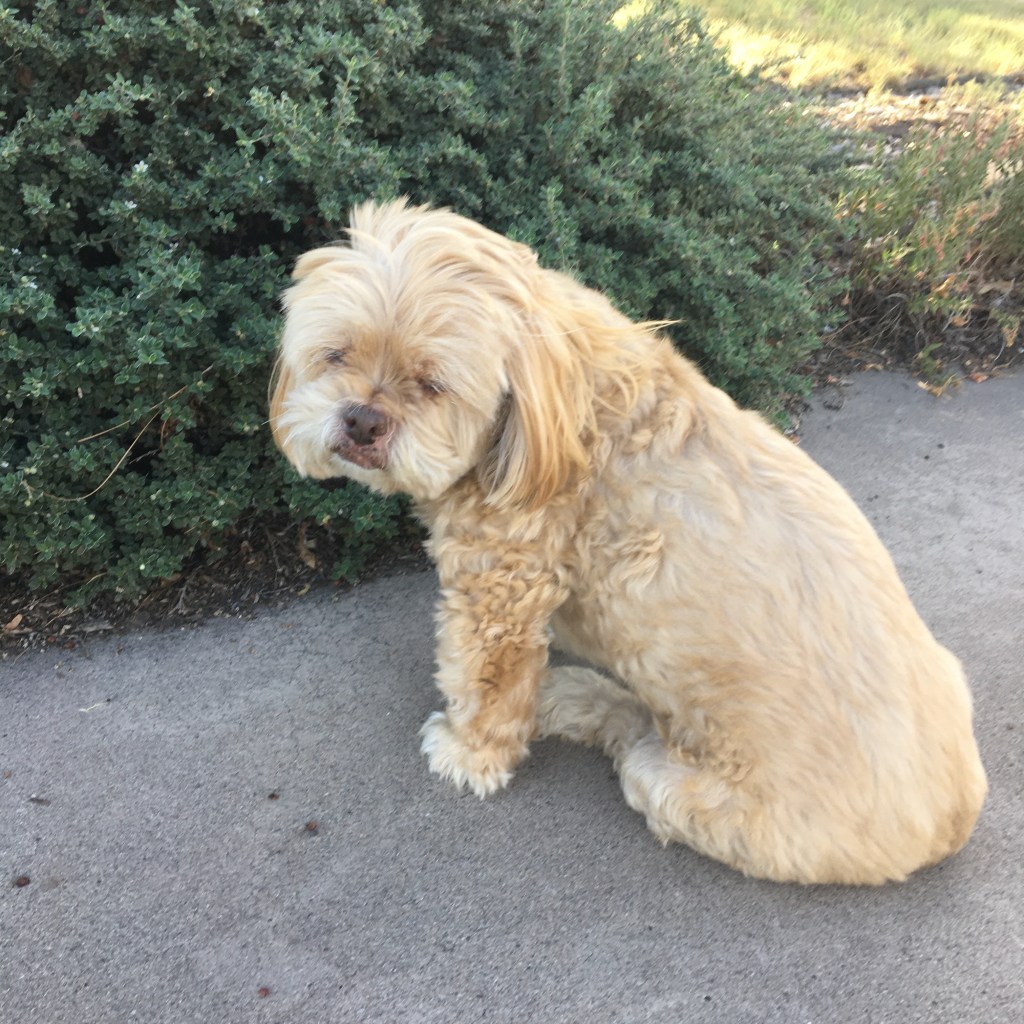
I’m not used to dog anatomy terms. I never thought of a dog having knees, but that’s what Sophie’s vet called them. Then I started to think a dog would have two sets of knees. But that doesn’t work out. The dog must have elbows in the front and knees behind, like humans (if we’re on all fours).

She’s been scooting across the floor, propelling with her front legs, and only occasionally getting up on all four. She’s better in the mornings, after a long night’s rest. 

We thought it was her back that was the problem. And I’ve done a lot of hefting around of 20 pounds of dog.

Saturday

Sophie’s appointment finally arrived and the vet took X-rays. 

I wish I had taken a photo of the X-ray showing her knees. She even has kneecaps, if maybe not now in the right places. Torn ligaments is the cause. All this, along with arthritis, especially in her right knee.

The vet suggested some kind of sling to help support her back end. Also, the possibility of physical therapy.

Sunday

What’s going on?

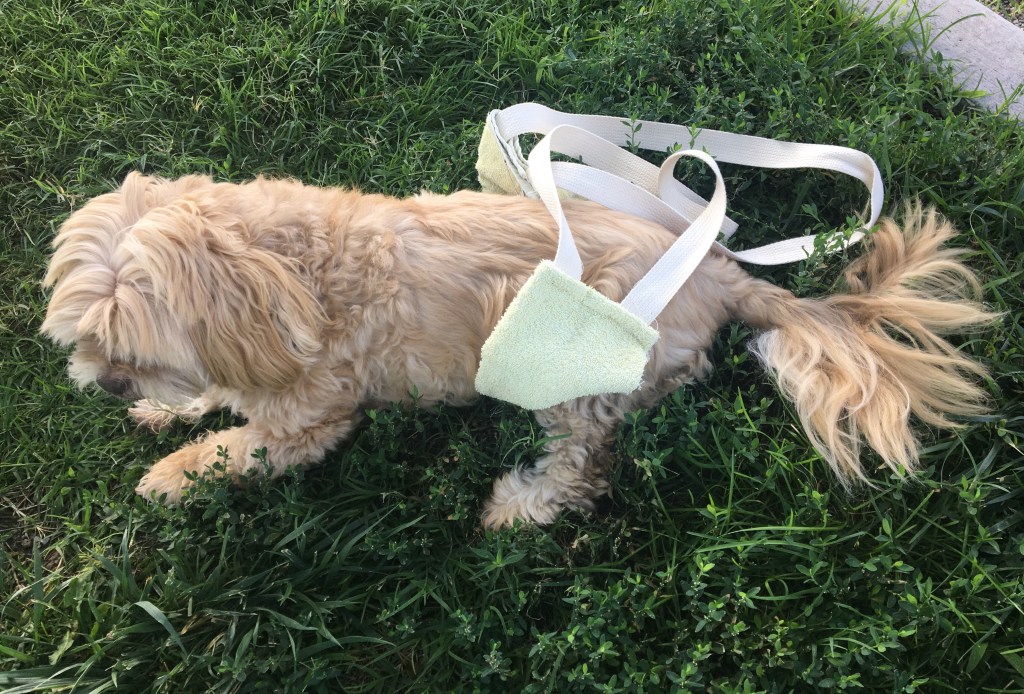
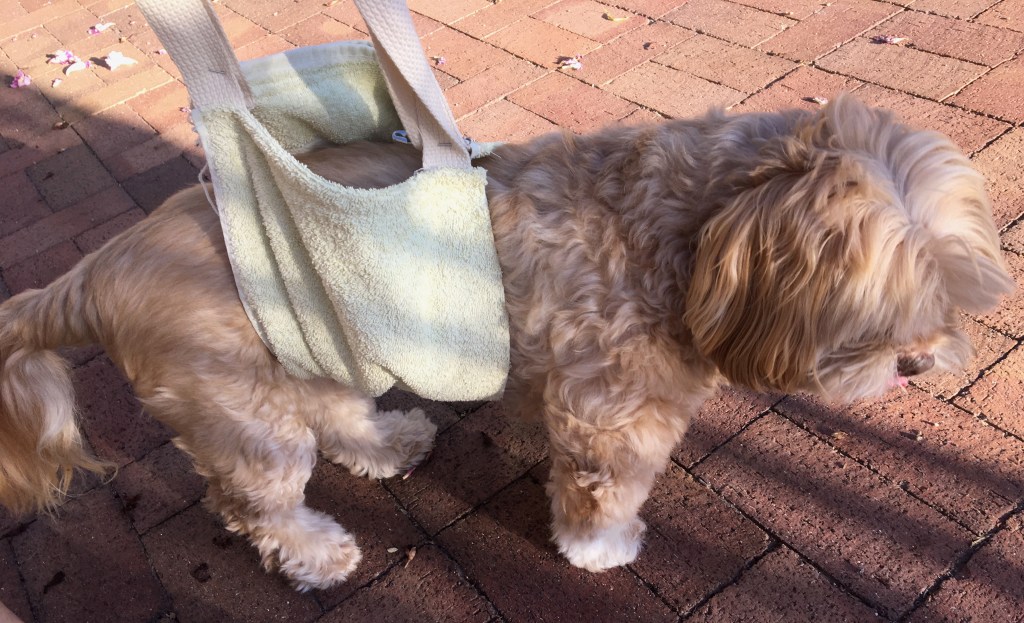
 Before shopping to see what dog slings might look like, I cobbled together a towel and some strapping. 

Sophie didn’t know what was going on and refused to cooperate. “Just carry me, already! Like you’ve been doing.”

Monday

We tried the sling again. 

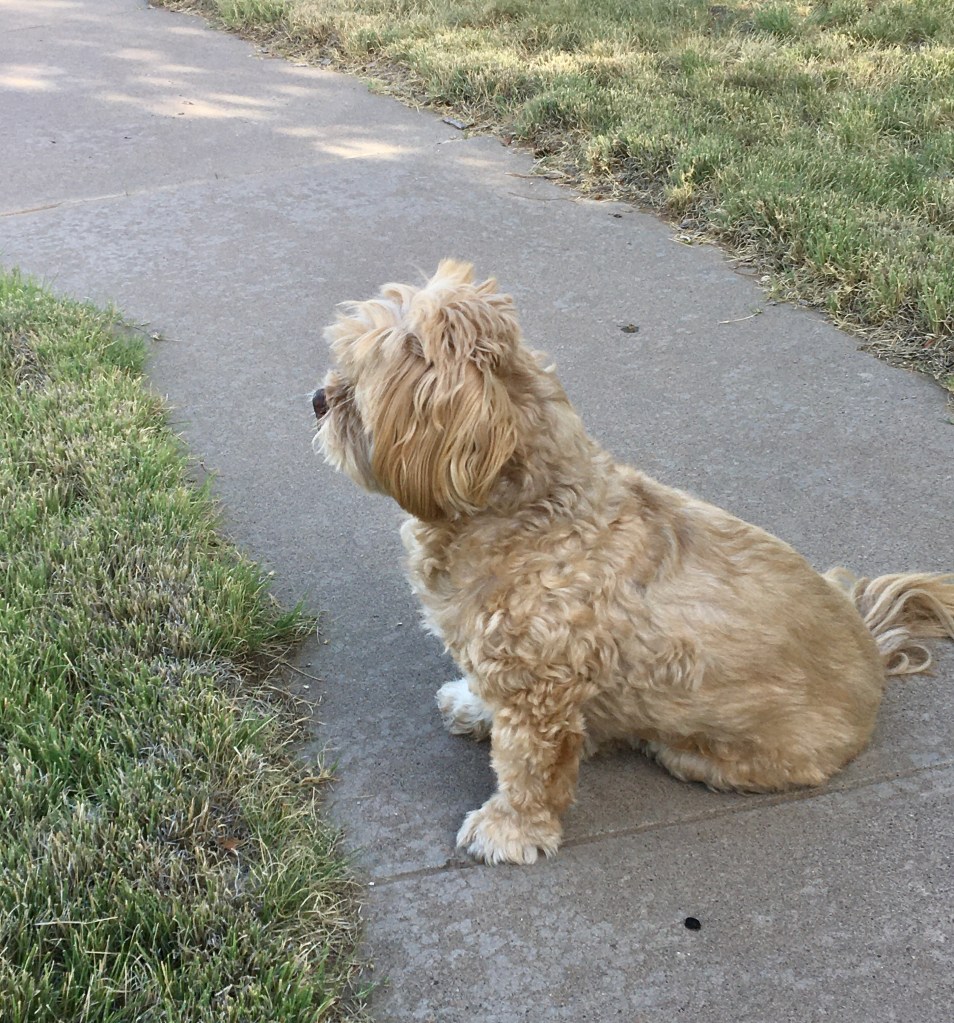
This time, Sophie discovered she could actually travel. She had a great time, taking in all the smells she’d missed during these weeks of no real walking.

She actually reached the park, and got to say “hello” to her terrier friend Coach. (Coach has issues with most of the dogs, but he and Sophie are very polite to each other.)

Then she lay down on the sidewalk. I carried her home.

Tuesday

I’m tired. And I need a haircut.

Sophie was even more ready to get harnessed up. But we didn’t go nearly as far.

I carried her home again.

Progress is not a steady climb. We’ve got to expect some dips. I’m going to try adjusting the sling.

Messy Creativity

I find it reassuring to know that creativity is often messy.

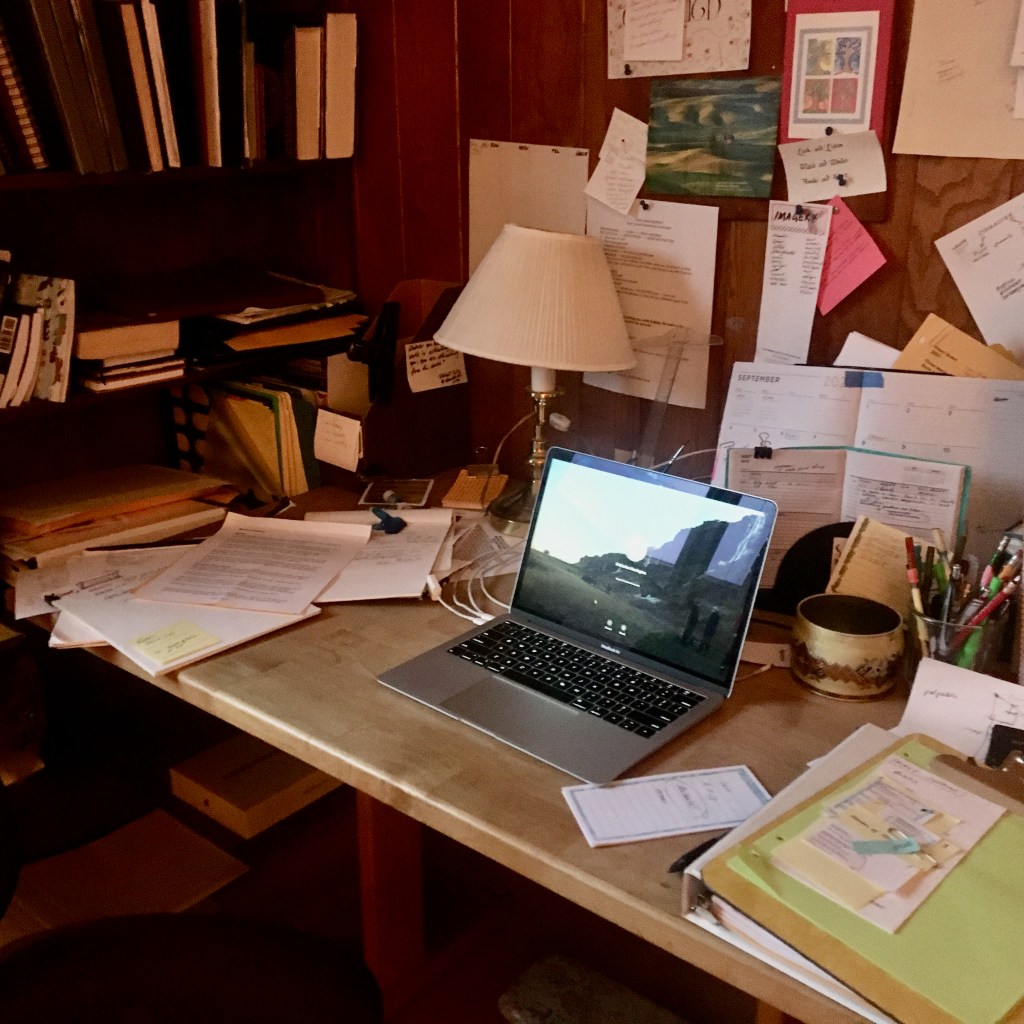
I have the ability to clutter anything: my desk (er, desks); my spot at the kitchen table; my bedside stand; anywhere I plant myself to solve newspaper puzzles.

I created a workspace out of half of our den. The half away from the fireplace. The window half. I love the morning sunlight. And I have not one but three work surfaces.

A treasure

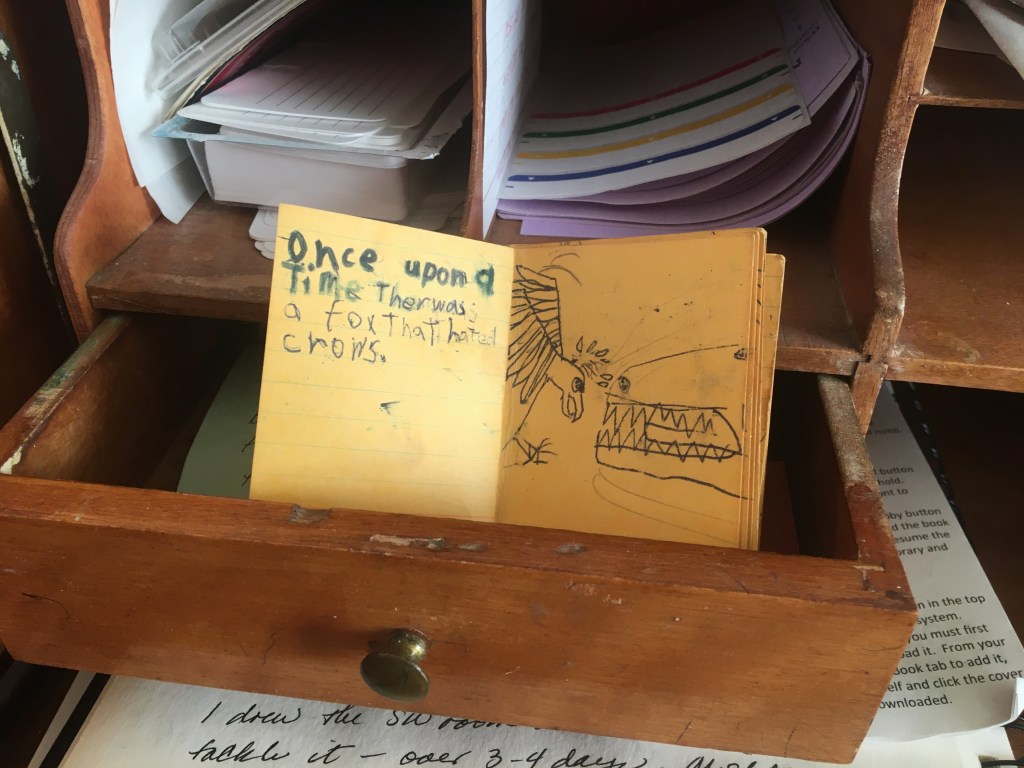
The oldest is a drop-leaf desk. Years ago, I stripped thick white paint from it. It had been green before that. One of its small drawers holds the book my daughter wrote in second grade. I reserve that desk for making journal entries, and work on other than fiction writing.

The other desk I also stripped—down to its lovely oak— but it really needs a taller owner, being an inch higher that my other surfaces. Consequently, it acts as a catch-all. 

The table is where I really sprawl. Some mornings I have to excavate to locate my laptop. 

Another Mess

It’s always seemed to me I should be more orderly. After all, that’s what a librarian is. Orderly. Right?

I do try, The last time I acted to find a “home” for everything, I had to hunt and wrack my brain before remembering where I had put whatever I was searching for.

Right now, I’d dearly love to find the notes from a recent workshop I attended.

Projects

I’m supposed to be working on the final volume of my trilogy—and I am. But I didn’t want to let go of the work on a verse novel, which I resumed during my sci-fi break.

To do both seemed impossible. Bouncing back and forth between future and distant past. How to maintain the sense of two worlds?

Solution: More Desks

We have another room—called the “mail room” because that’s where the mail enters the house. (Yes, we’re lucky!)  It contains the computer desk. we used to share, back before laptops. It became my husband’s work space. But when his last laptop died, he declined to replace it. 

I really didn’t want to lose the momentum on the verse novel. Why not take that particular world to a separate room, to a separate desk, at a different, designated time of day?

The good news is it’s working. At least for the verse novel.

The bad news is I’m having trouble resolving sci-fi dilemmas created in the previous two volumes . . . 

You could call it a writer’s block. But I am thinking about it daily. . 

I just need to clear this workspace and maybe . . .

Sophie

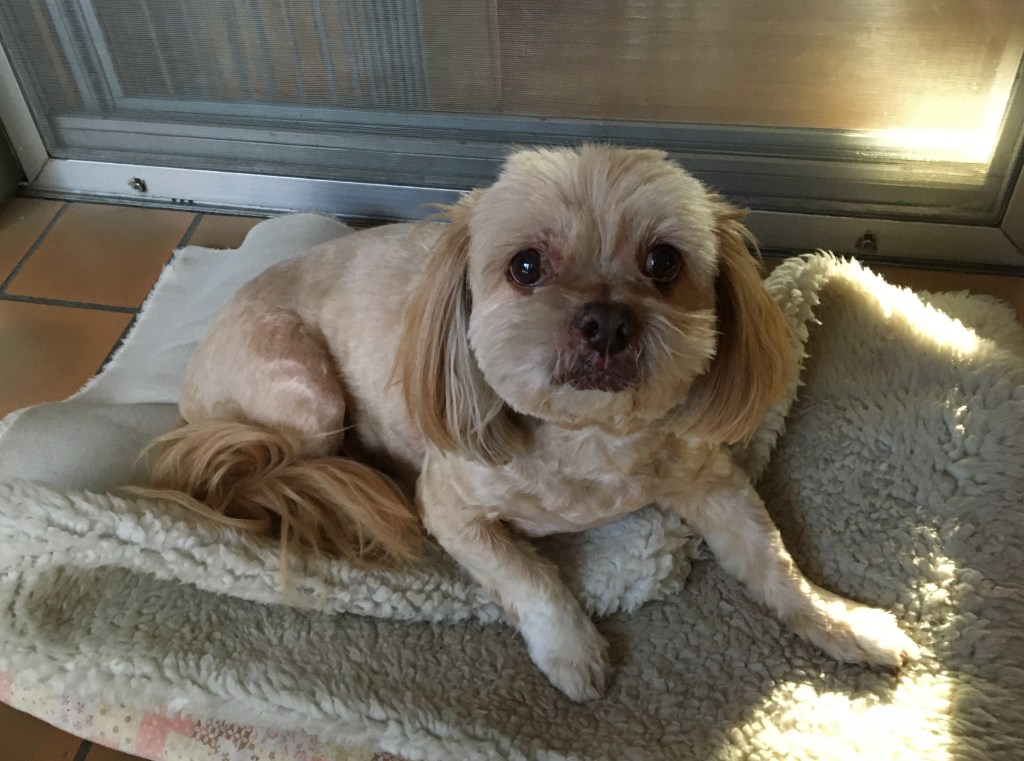
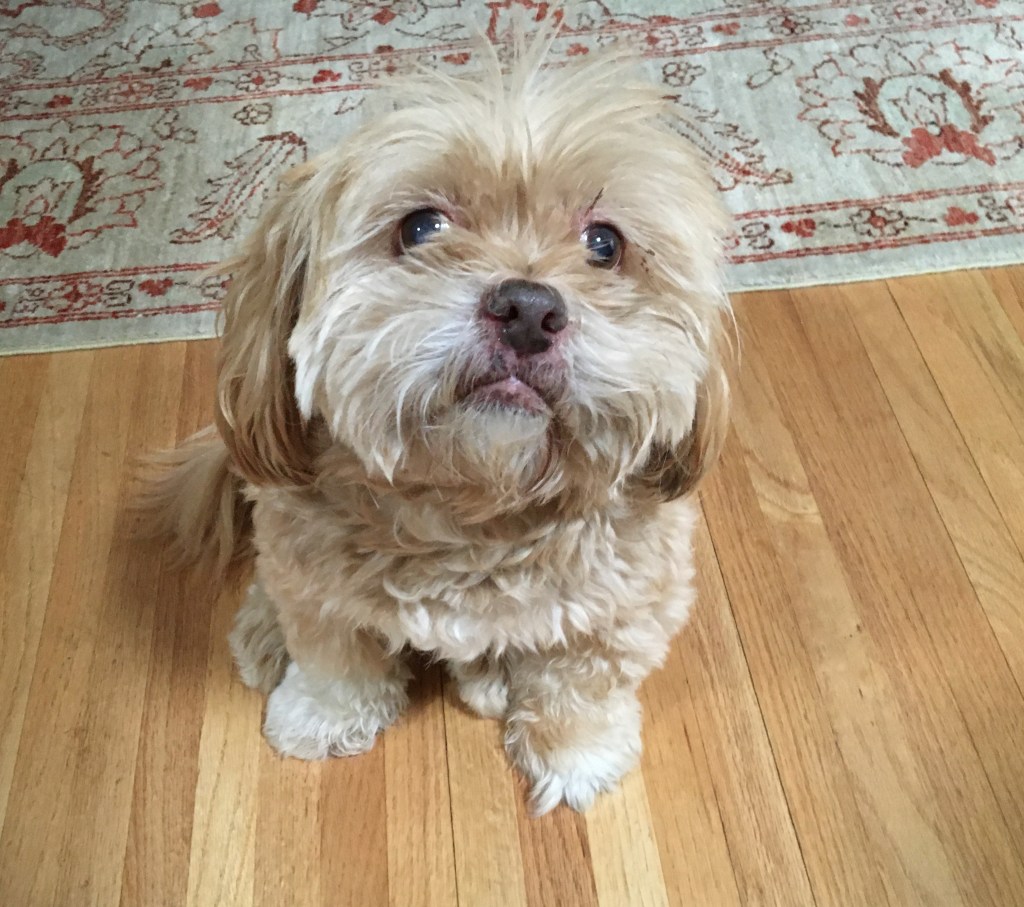
Sophie is very much alive, just not exactly kicking.

From the beginning, veterinarians warned us that she would be prone to arthritis, due to her bowed legs and the way her body is constructed. She’s been taking daily doggie doses of glucosamine chondroitin for years.

This past year, she’s found it difficult to get herself in motion. Her back legs would hesitate and limp until she shook herself and got them activated. 

I’m ready for a lift, please.

And then, about six weeks ago, they grew a whole lot worse. Her back legs don’t want to work at all, particularly the left one. She can get on her feet and hobble, but a lot of her travel is scooting on her bottom. She’s really developing those shoulder muscles, since they have to do most of the work.

We’re developing our shoulder muscles too! Hefting twenty pounds of dog around builds muscles, but I’m finding it hard on my knees.

Sophie’s first vet visit resulted in a prescription for NSAIDS, and the recommendation of acupuncture or other therapy. She’s had two acupuncture appointments, with uncertain results.

Someone’s coming.

The good news is Sophie retains her-humor, her appetite, and her interest in everything going on around her.

The labor shortage is evident here. Our vet clinic is down one doctor, so Sophie’s next visit isn’t until the end of the month. And our spring AC checkup got postponed till July due to our Covid. Now it’s been postponed until August! due to their staff shortages.

Does anyone know where we can find doggie wheels?

Do they make strollers for dogs?

Rueful Thoughts

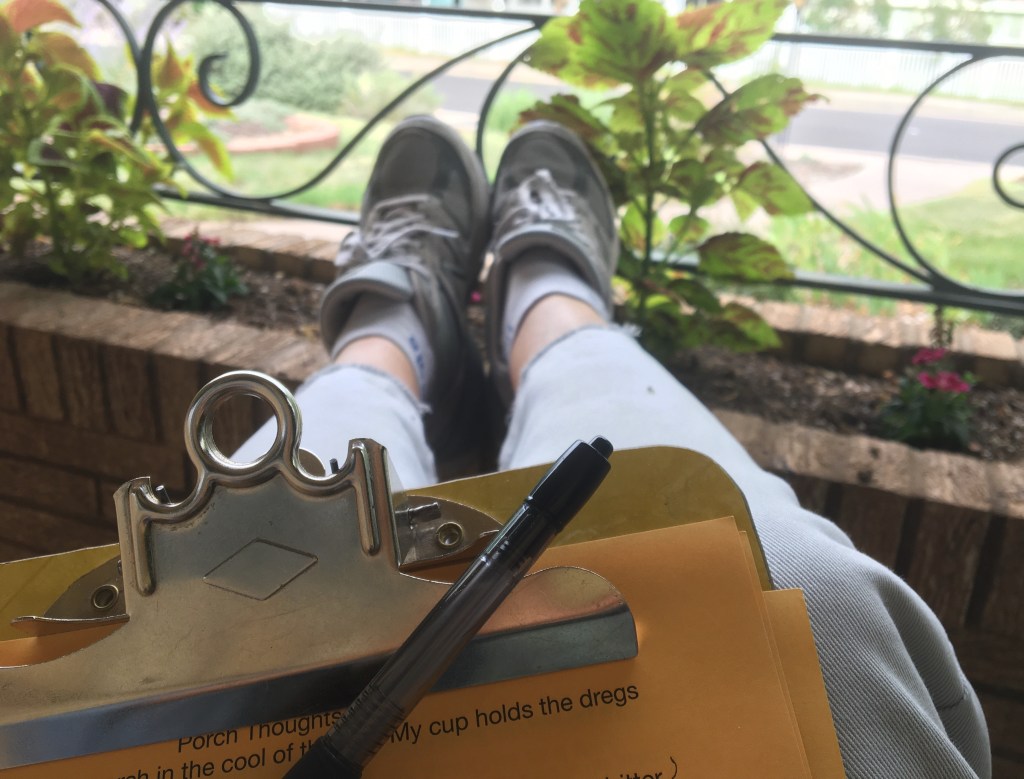
I’m back on my front porch in the cool of the day. My cup holds the dregs of a pot of tea—strong and bitter

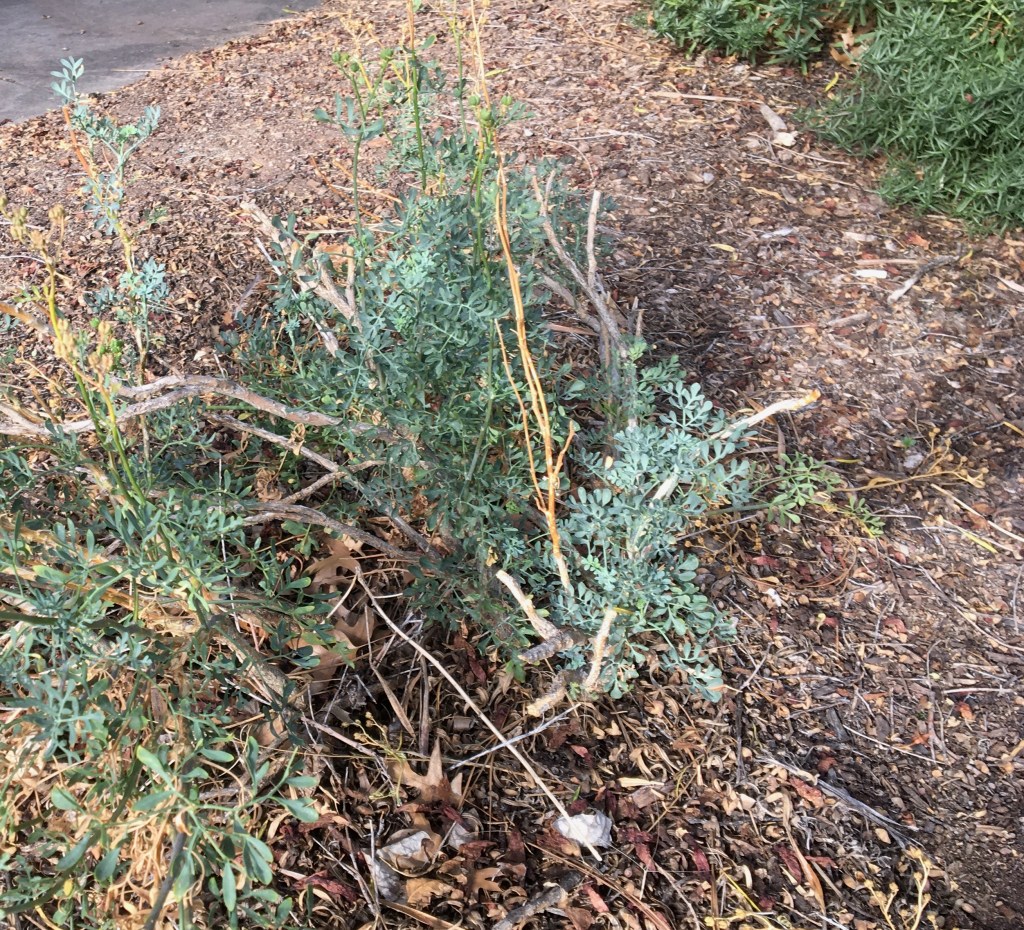
I’ve never tasted the herb rue, but it must also be bitter to match its name. I have one straggly rue plant in my neglected herb garden. Since it’s survived from the time we landscaped—well over twenty years—I’m thinking I need to plant more—and tend them better. Any plant that survives New Mexico is worth preserving!

Rue for Caterpillars

Rue

It was my friend Jane who reminded me of the rue. Some caterpillars eat the rue leaves. Jane’s hobby is raising and releasing butterflies. She wanted to know if our rue held any eggs, but no such luck. She did nip off a few seed pods, saying they sap the plant of energy. I’m going to see if any will sprout.

Ruing the Present

Do you wonder what is real and what is fake in Congress? Do our representatives work for the hard choices, looking to the future, or do they mouth words to gain votes for their next election?

Bernie Sanders gained peoples’ trust, with good reason. He’s a man with a history of working for the hard choices. A man from a small state. Democracy needs to be up close and personal to work.

In my last blog, I said we need a solution big enough to satisfy everyone. A recent NPR segment interviewed someone from a country that recently made abortion legal. (Mexico?) The interviewer asked if abortions had increased and was told “No.” With national health, anyone coming for an abortion also receives counseling and supportive measures (including contraceptives and/or vasectomies).

Why don’t we have national health? National health care is definitely one piece of that big solution. But instead, between profit-driven insurers and hospitals, and those opposing both abortion and contraceptives, we’ve been shunted down a rabbit hole of irrationality. 

What’s in a Name?

Rue is not a particularly attractive plant, but its name is quite evocative. Among other properties, it is an abortifacient.

The recent Supreme Court ruling on abortion, along with speculation that contraceptives might be under attack next, took my thoughts to a fairy tale. 

Rue in a Fairytale

A battered treasury of stories

There’s a Polish tale of King Bartek, a man who distrusts flattery. He trades places with his jester, and they go courting in a village where they’re not known. 

An ambitious girl pursues the ugly “King” and mocks her sister who is more attracted to the “Jester.” Who cares how old or ugly the man is, if you can become a queen? Of course, it is her sister who ends up happily ever after, for following her heart.

The last lines of the tale imply a bitter reality concerning the greedy sister, who “had to grow sixteen beds of rue before she married an old organist.

Did the storyteller intend those sixteen beds of rue to be a metaphor of regret? Or did she also require the herb’s services?

Converging Thoughts

You’ll understand some day.” 

A recent This American Life program pointed out that we think we know all there is to know of something, until we realize we’ve never grasped its greater reality. 

We have to reach that a particular level of age and experience to see matters from a different angle. I think I’ve reached that greater age, grasped that greater reality, when looking at my husband. 

As children, as young adults, it’s easy to look at someone and think dismissively: He’s old, or She’s old. We have a limited set of eyes when young. Through living, we grow a second set of eyes. Yes, my husband’s body is aging, but the one inhabiting his body remains the dear, caring, careful man he’s always been. 

We are always the same age inside.”

A clue in a crossword puzzle offered the above quote by Gertrude Stein. That quote shunted my train of thought onto a related track. I don’t think we can fasten a number on Stein’s “same age.

I’m still that Kindergartner afraid of getting lost inside the church where our class met. I’ve always felt younger than my contemporaries, (blaming it on starting first grade before I was six). But now I think it’s more a matter of who I am—undecided, off-balance, needing quietude to stay centered.

Maybe what Stein calls “the same age” is an agelessness; an age we are constantly growing into, adding experiences to, but not aging into old age. Not if we pay attention.

Paying Attention

The morning after the 4th of July, I sat out on our porch watching the cloudy day brighten. The newspaper’s holiday shootings piled onto the many other matters weighing down the scales of injustice. 

Outside the bubble.

My heart and soul ached for relief. I realized I was outside of my protective bubble. I don’t feel that ache nearly often enough. 

Instead I move into my bubble to shut out pain. I read an old, familiar—safe—novel. I immerse myself in writing fictions of my own. I quilt to justify watching DVDs. I turn off NPR news when I can bear no more.

But bubbles burst so easily, so suddenly, so devastatingly. Bubbles burst for the parents of Uvalde, for the random shootings across the country, for those trapped by insurmountable hospital bills, unexpected pregnancies, storms, floods, fires or any of the infinite emergencies that affect any of us.

I’ll keep you company.

What can we do? We don’t need a leader so much as we need a solution to fight for, a solution large enough to satisfy everyone. A solution that looks beyond hype, even beyond hope.

I need to sit on the porch more often. 

Thoughts about SCOTUS

At the time of my third pregnancy (my last pregnancy) my custom was to strap my 3 year old son into his bike seat and set out for a ride after his older brother left for school. He would fall asleep on the ride, and I’d return home ready to take on household chores.

That ended. 

Those rides ended because of a fetus. My daughter declared I was not to risk myself in any way. I was to take every precaution for her safety and well-being. SHE was in charge now, thank you very much!

The Supreme Court is made up of nine individuals. Six of those individuals are men. 

Five of those men and one woman have an agenda that does not include EMPATHY, COMPASSION, nor a HOLISTIC VIEW of what it means to be human.

  • It’s time the Supreme Court looked like the country it stands in judgment over.
  • It’s time the Supreme Court represented every sex, color, and creed of their constituents.
  • And it’s time the Supreme Court (as well as lower court judges) did not received lifetime tenures.

If men were forced to tolerate

  • a life-form inhabiting their bodies for nine months
  • a life-form threatening their health
  • a life-form controlling their emotions and lives and economics for many years to come

they might gain some feeling for how childbirth changes a woman’s life. 

And the above list says nothing about medical issues eroded away when state legislatures step way out of bounds to control the actions of health care workers. 

How many children—out of neglect due to a parent or parents working multiple jobs to support them—turn to guns? This same Supreme Court, in another recent ruling, values guns more than children. 

This court, with its partisan politics, did not create itself. We’ve come a long way, women. My mother was born in 1920, the year we gained the right to vote. 

One hundred and two years later, it’s time to vote

  • for our lives
  • for our daughters’ lives
  • for our sons’ lives
  • and for lives on every spectrum of the sexual scale

The Water Barrel Paradox

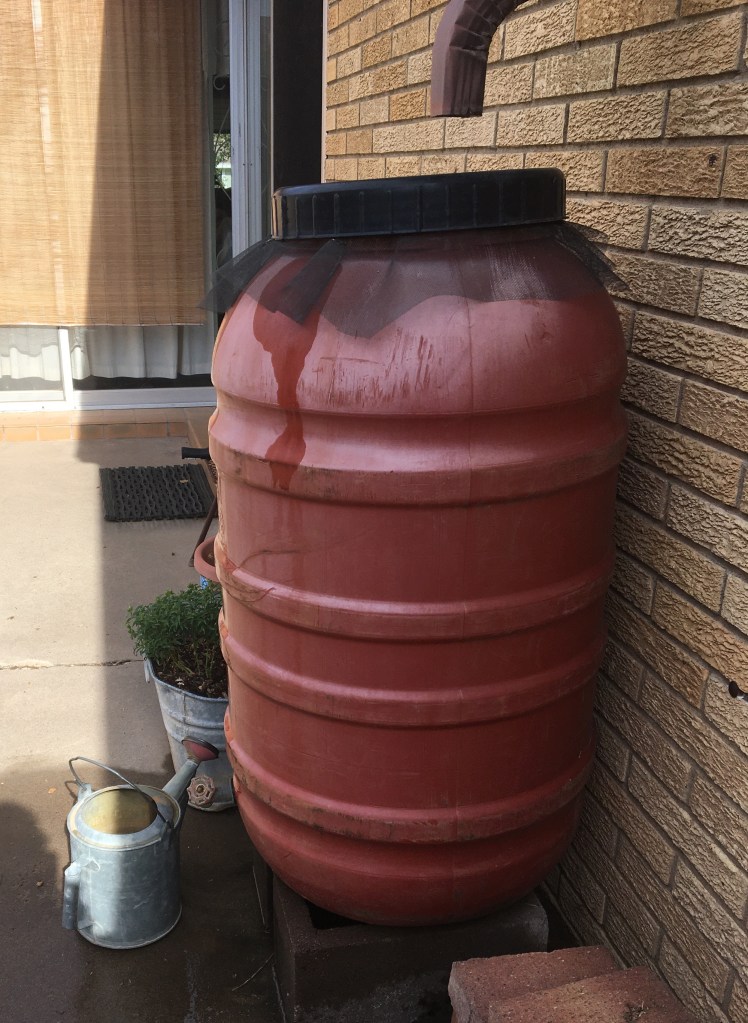
We have three water barrels. The city’s water utility department offers a rebate. Nice. We had to replace one and got another rebate.

Two containers are in the backyard. By attaching a hose, we can drain off the water under the apricot tree, or move it around the edges of the yard.  The third barrel is beside our driveway, with a hose permanently attached and the spigot permanently turned to open, directing rain waters across the walkway into the rose bed. 

My problem is I’m a hoarder—not in the cluttered house sense, but in the save for a rainy day sense. Except with a rain barrel, you want the barrel empty by the time that rainy day comes.

After months of no rain, they’ve been empty a long time. We finally got a really nice shower, with thunder, and a steady fall of water lasting an hour or more. The barrels require no more than a quarter-inch of rainfall on the roof to fill up. 

The temptation is to hang onto the water. After all, the yard just got rained on! But there’s more rain to come. So far, I’ve emptied both barrels twice—on an already wet yard. The alternative is to let the barrels overflow. 

I have a lavender plant that extends six feet along the edge of the patio. It grew that large by soaking up patio runoff plus all the barrel overflow.

A minor conundrum

None of my standard tomato plants have put on any fruit yet. Maybe the nights have been too warm.

The one exception is a cherry tomato. A prolific tomato:

Indigo Cherry Drops.”

I kept wondering how I would know when they were ripe.

I finally looked online—the wonders of the Internet!—and discovered they will indeed turn red (with bluish highlights) or maybe even purplish, when ripe.

They’re finally taking on some color. I can’t wait! 

And the rain barrels?

Right now, I believe there’s more rain to come. But . . .

When do I get to hang onto the stored water?

Variations on a Theme

Today’s blog is going to be a miscellany, because I haven’t come up with a topic.

Voluntary Larkspurs bring joy.

Gardening

I’ve been watering our raised beds and containers nightly because of the hot dry days. In spite of adding “good” dirt to the raised beds, those plants seem to be suffering almost as much as last year. 

This got me comparing containers. We ended big-time composting a few years back, when it became too much. Then late last summer I began composting the kitchen scraps, because of the success reported by a friend. 

Two galvanized bins received a topping of new compost. They have happy plants. Another small container, filled only with the “good” dirt, holds slower growing plants. Be aware, this report is unscientific. The slower plants are also in a shadier location. 

At the risk of more uncooked seeds sprouting, I just spread my newest batch of compost over the two raised beds. I’ll let you know if it acts as encouragement to those veggies.

My work

These last weeks, beginning with my week of Covid, have been up-and-down mood-wise. A week of no work pushed me out of my then-project with my verse novel. (To call it my “Zen project” works equally well, because of the quiet pleasure it gave me).

That grumpy week was followed by bouts of near-depression, until I told myself: “It is what it is. Make the most of it.” Making the most of it worked. I had just begun a class on the plotting and structuring of verse novels. Being outside of my project made analysis (not my strong suit) more possible. I now have a better map of my protagonist’s arc.

My Reading

I’m more likely to read non-fiction when actually writing, as opposed to when wearing revision or editing caps. It’s all part of the work, but there’s a big difference in the kind of thinking cap worn. Thanks, Betsy James, for the hat analogy!

I’ve set a goal of completing a full draft of Book 3 of my sci fi trilogy by the end of the year. My reading choices reflect that I’ve already made that transition.

My library hold arrived of Ann Patchett’s new book of essays These Precious Days and I’m finding it hard to put it down. Then too, my rather daunting stack of partially read magazines is screaming for me to whittle away at that backlog.

The theme of the day is to make the most of what comes our way

A recent news article raises the hope that Earth’s fiery, stormy tantrums are finally gaining the attention of climate-naysayers. May it be so.

Speculating

I think one of the reasons I write science fiction, AKA speculative fiction, is the chance to imagine the world as it might become. I found science fiction at the library as a child.

 It was sometime later that I discovered what I call speculative non-fiction. Big Foot, Yetis, extraterrestrial contacts with humans . . . Many were flights of the imagination with little connection to reality. But I read with an open mind, waiting till later to decide what I believed.

One topic I still believe in is Sir Alistair Hardy’s theory that humans went through a semi-aquatic period early in our history. Welsh writer Elaine Morgan popularized the Aquatic Ape theory, with her meticulously researched books. The theory explains, among other things, how we lost our fur, and why we’re born with a layer of subcutaneous fat. 

Morgan was shunned by the scientific community two generations ago. From articles I read from time to time, I think research is being done now, but there’s an unwillingness to even mention the theory by name.

My friend Judy Kaul wrote a children’s introduction to the theory.

Oumuamua

I’ve just read a library book by Avi Loeb, extraterrestrial, The First Sign of Intelligent Life Beyond Earth, about that fast moving object from interstellar space spotted in 2017, named Oumuamua, Hawaiian for “scout.” Loeb’s hypothesis is that it might have been “extraterrestrial technological equipment.” 

There are many anomalies that make Oumuamua different from the usual comet or meteor. But Loeb is receiving a lot of pushback from his hypothesis. Is it that the scientific community doesn’t want to admit there might be other intelligence in the galaxy?

Loeb has headed Harvard’s astronomy department, and has led many research projects. He argues that the scientific community should be more open about their research—before announcing breakthroughs, since it’s our tax dollars paying for much of it. Also, publicizing research questions might inspire new generations to pursue science.

This particular question of other intelligent life in the galaxy is at the heart of many a science fiction story.

Loeb says: “But the moment we know that we are not alone, that we are almost certainly not the most advanced civilization ever to have existed in the cosmos, we will realize that we’ve spent more funds developing the means to destroy all life on the planet than it would have cost to preserve it.”

Avi Loeb elsewhere in the book says: “But no civilizations . . . will make the leap to migrating out among the stars if they are not smart enough to preserve their home planets . . .”

I say bravo! Why are we still pursuing nuclear weapons when we have a planet heating up, and need to devote all our energy and resources to saving Earth?

You don’t mean me, do you?

HEART SICK

The timing of Memorial Day and recent shootings at Uvalde and in Buffalo, makes me want to rant about guns, and to rant about the parallels I see between guns and drone strikes and bombs and wars—endless wars. 

We need healthcare for all, and attention to mental health in every school. Why don’t we insist on mental health for governments too?

I hope to resume a normal blog next week.