Thoughts about SCOTUS

At the time of my third pregnancy (my last pregnancy) my custom was to strap my 3 year old son into his bike seat and set out for a ride after his older brother left for school. He would fall asleep on the ride, and I’d return home ready to take on household chores.

That ended. 

Those rides ended because of a fetus. My daughter declared I was not to risk myself in any way. I was to take every precaution for her safety and well-being. SHE was in charge now, thank you very much!

The Supreme Court is made up of nine individuals. Six of those individuals are men. 

Five of those men and one woman have an agenda that does not include EMPATHY, COMPASSION, nor a HOLISTIC VIEW of what it means to be human.

  • It’s time the Supreme Court looked like the country it stands in judgment over.
  • It’s time the Supreme Court represented every sex, color, and creed of their constituents.
  • And it’s time the Supreme Court (as well as lower court judges) did not received lifetime tenures.

If men were forced to tolerate

  • a life-form inhabiting their bodies for nine months
  • a life-form threatening their health
  • a life-form controlling their emotions and lives and economics for many years to come

they might gain some feeling for how childbirth changes a woman’s life. 

And the above list says nothing about medical issues eroded away when state legislatures step way out of bounds to control the actions of health care workers. 

How many children—out of neglect due to a parent or parents working multiple jobs to support them—turn to guns? This same Supreme Court, in another recent ruling, values guns more than children. 

This court, with its partisan politics, did not create itself. We’ve come a long way, women. My mother was born in 1920, the year we gained the right to vote. 

One hundred and two years later, it’s time to vote

  • for our lives
  • for our daughters’ lives
  • for our sons’ lives
  • and for lives on every spectrum of the sexual scale

The Water Barrel Paradox

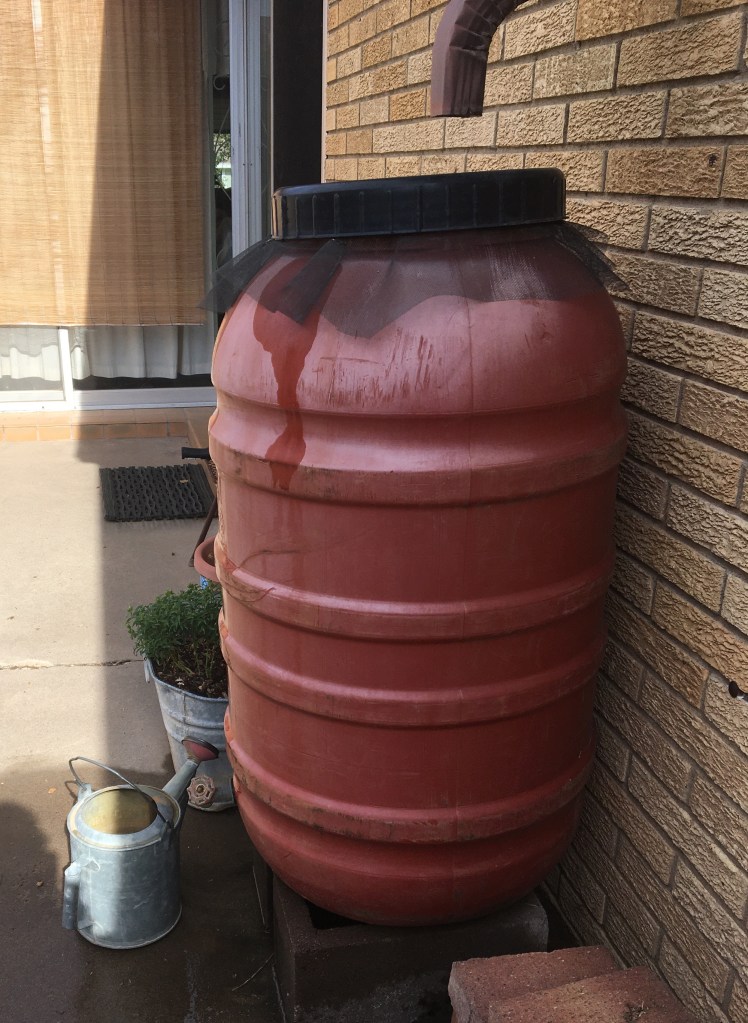
We have three water barrels. The city’s water utility department offers a rebate. Nice. We had to replace one and got another rebate.

Two containers are in the backyard. By attaching a hose, we can drain off the water under the apricot tree, or move it around the edges of the yard.  The third barrel is beside our driveway, with a hose permanently attached and the spigot permanently turned to open, directing rain waters across the walkway into the rose bed. 

My problem is I’m a hoarder—not in the cluttered house sense, but in the save for a rainy day sense. Except with a rain barrel, you want the barrel empty by the time that rainy day comes.

After months of no rain, they’ve been empty a long time. We finally got a really nice shower, with thunder, and a steady fall of water lasting an hour or more. The barrels require no more than a quarter-inch of rainfall on the roof to fill up. 

The temptation is to hang onto the water. After all, the yard just got rained on! But there’s more rain to come. So far, I’ve emptied both barrels twice—on an already wet yard. The alternative is to let the barrels overflow. 

I have a lavender plant that extends six feet along the edge of the patio. It grew that large by soaking up patio runoff plus all the barrel overflow.

A minor conundrum

None of my standard tomato plants have put on any fruit yet. Maybe the nights have been too warm.

The one exception is a cherry tomato. A prolific tomato:

Indigo Cherry Drops.”

I kept wondering how I would know when they were ripe.

I finally looked online—the wonders of the Internet!—and discovered they will indeed turn red (with bluish highlights) or maybe even purplish, when ripe.

They’re finally taking on some color. I can’t wait! 

And the rain barrels?

Right now, I believe there’s more rain to come. But . . .

When do I get to hang onto the stored water?

Variations on a Theme

Today’s blog is going to be a miscellany, because I haven’t come up with a topic.

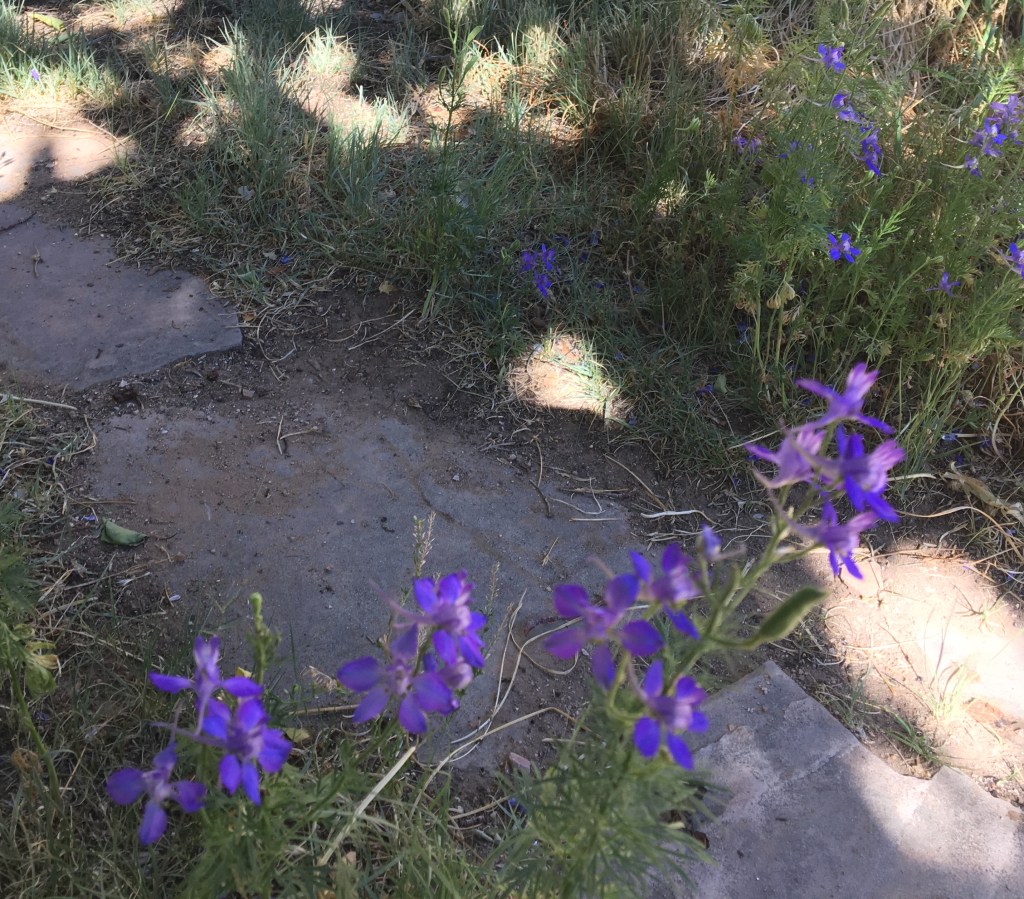
Voluntary Larkspurs bring joy.

Gardening

I’ve been watering our raised beds and containers nightly because of the hot dry days. In spite of adding “good” dirt to the raised beds, those plants seem to be suffering almost as much as last year. 

This got me comparing containers. We ended big-time composting a few years back, when it became too much. Then late last summer I began composting the kitchen scraps, because of the success reported by a friend. 

Two galvanized bins received a topping of new compost. They have happy plants. Another small container, filled only with the “good” dirt, holds slower growing plants. Be aware, this report is unscientific. The slower plants are also in a shadier location. 

At the risk of more uncooked seeds sprouting, I just spread my newest batch of compost over the two raised beds. I’ll let you know if it acts as encouragement to those veggies.

My work

These last weeks, beginning with my week of Covid, have been up-and-down mood-wise. A week of no work pushed me out of my then-project with my verse novel. (To call it my “Zen project” works equally well, because of the quiet pleasure it gave me).

That grumpy week was followed by bouts of near-depression, until I told myself: “It is what it is. Make the most of it.” Making the most of it worked. I had just begun a class on the plotting and structuring of verse novels. Being outside of my project made analysis (not my strong suit) more possible. I now have a better map of my protagonist’s arc.

My Reading

I’m more likely to read non-fiction when actually writing, as opposed to when wearing revision or editing caps. It’s all part of the work, but there’s a big difference in the kind of thinking cap worn. Thanks, Betsy James, for the hat analogy!

I’ve set a goal of completing a full draft of Book 3 of my sci fi trilogy by the end of the year. My reading choices reflect that I’ve already made that transition.

My library hold arrived of Ann Patchett’s new book of essays These Precious Days and I’m finding it hard to put it down. Then too, my rather daunting stack of partially read magazines is screaming for me to whittle away at that backlog.

The theme of the day is to make the most of what comes our way

A recent news article raises the hope that Earth’s fiery, stormy tantrums are finally gaining the attention of climate-naysayers. May it be so.

Speculating

I think one of the reasons I write science fiction, AKA speculative fiction, is the chance to imagine the world as it might become. I found science fiction at the library as a child.

 It was sometime later that I discovered what I call speculative non-fiction. Big Foot, Yetis, extraterrestrial contacts with humans . . . Many were flights of the imagination with little connection to reality. But I read with an open mind, waiting till later to decide what I believed.

One topic I still believe in is Sir Alistair Hardy’s theory that humans went through a semi-aquatic period early in our history. Welsh writer Elaine Morgan popularized the Aquatic Ape theory, with her meticulously researched books. The theory explains, among other things, how we lost our fur, and why we’re born with a layer of subcutaneous fat. 

Morgan was shunned by the scientific community two generations ago. From articles I read from time to time, I think research is being done now, but there’s an unwillingness to even mention the theory by name.

My friend Judy Kaul wrote a children’s introduction to the theory.

Oumuamua

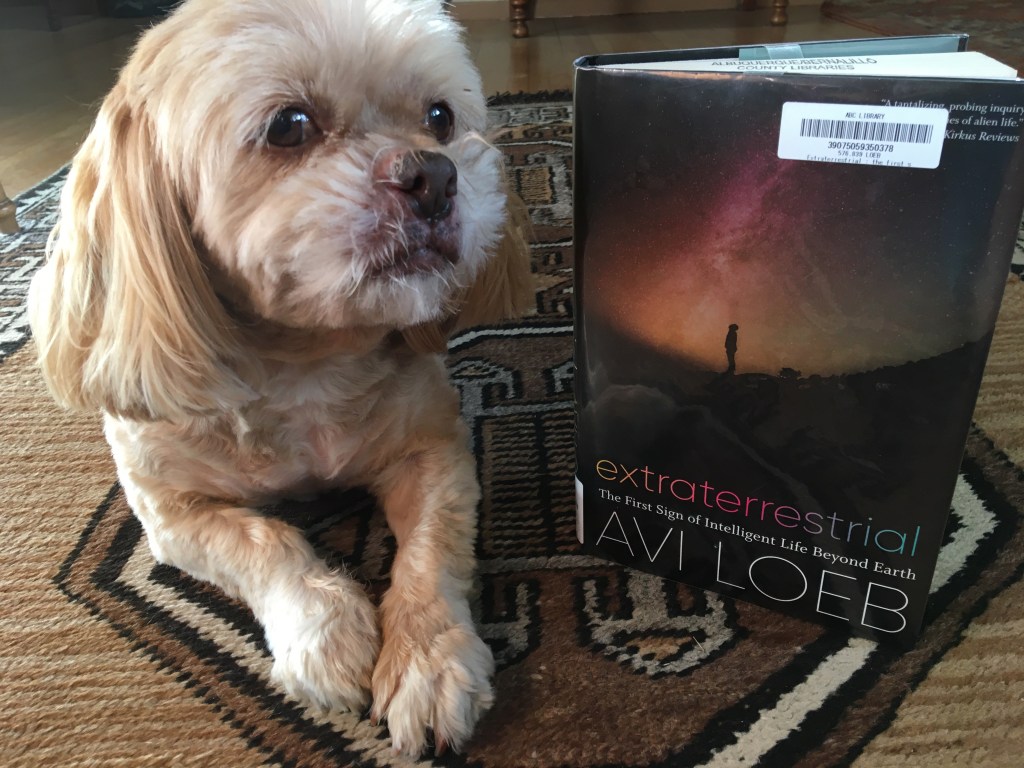
I’ve just read a library book by Avi Loeb, extraterrestrial, The First Sign of Intelligent Life Beyond Earth, about that fast moving object from interstellar space spotted in 2017, named Oumuamua, Hawaiian for “scout.” Loeb’s hypothesis is that it might have been “extraterrestrial technological equipment.” 

There are many anomalies that make Oumuamua different from the usual comet or meteor. But Loeb is receiving a lot of pushback from his hypothesis. Is it that the scientific community doesn’t want to admit there might be other intelligence in the galaxy?

Loeb has headed Harvard’s astronomy department, and has led many research projects. He argues that the scientific community should be more open about their research—before announcing breakthroughs, since it’s our tax dollars paying for much of it. Also, publicizing research questions might inspire new generations to pursue science.

This particular question of other intelligent life in the galaxy is at the heart of many a science fiction story.

Loeb says: “But the moment we know that we are not alone, that we are almost certainly not the most advanced civilization ever to have existed in the cosmos, we will realize that we’ve spent more funds developing the means to destroy all life on the planet than it would have cost to preserve it.”

Avi Loeb elsewhere in the book says: “But no civilizations . . . will make the leap to migrating out among the stars if they are not smart enough to preserve their home planets . . .”

I say bravo! Why are we still pursuing nuclear weapons when we have a planet heating up, and need to devote all our energy and resources to saving Earth?

You don’t mean me, do you?

HEART SICK

The timing of Memorial Day and recent shootings at Uvalde and in Buffalo, makes me want to rant about guns, and to rant about the parallels I see between guns and drone strikes and bombs and wars—endless wars. 

We need healthcare for all, and attention to mental health in every school. Why don’t we insist on mental health for governments too?

I hope to resume a normal blog next week.

Setting Goals

My earlier attempt to set a goal doing a little yoga every day fizzled out after little more than a week. I still do bits of yoga, but not regularly.

And then came the lost week of Covid when I did nothing at all. Well, hardly anything. The dishes got done. The clutter grew. Even our Roomba took a break.

It occurred to me that I needed to keep any goal setting within reason. Like do something within a week (rather than daily).

My dear friend Jane gifted us with an oximeter and a thermometer and they still sat on the living room table. The bathroom drawers were a cluttered mess. Why not sort out the bathroom and make space? 

Deadline one week.

I did it in three sessions. First, emptying out two drawers and one cupboard. Amazing the finds that were tossed. Second, checking all other bathroom crannies. Finally, the external room remained.

Saturday came around. Time was up. Armed with bucket and stepladder: 

  1. In the doorway, I worked out which direction was clockwise (because of all these cleaning articles that tell you to clean around a room in a clockwise direction to not miss anything). 
  2. I wiped down all cabinet doors, walls, mirror, window—in order, of course!—and ended up mopping the floor. 

Amazing how good that room felt afterwards. And the bonus was that all the bending and stretching had made a great yoga workout as well!

This week’s goal? In keeping to small steps, there’s this desk I know of. And on that desk is a box of papers left over from tax season. The week’s already half over and I’m still avoiding it . . .

First Squash Blossom

The Wonders of Weeds

elm tree

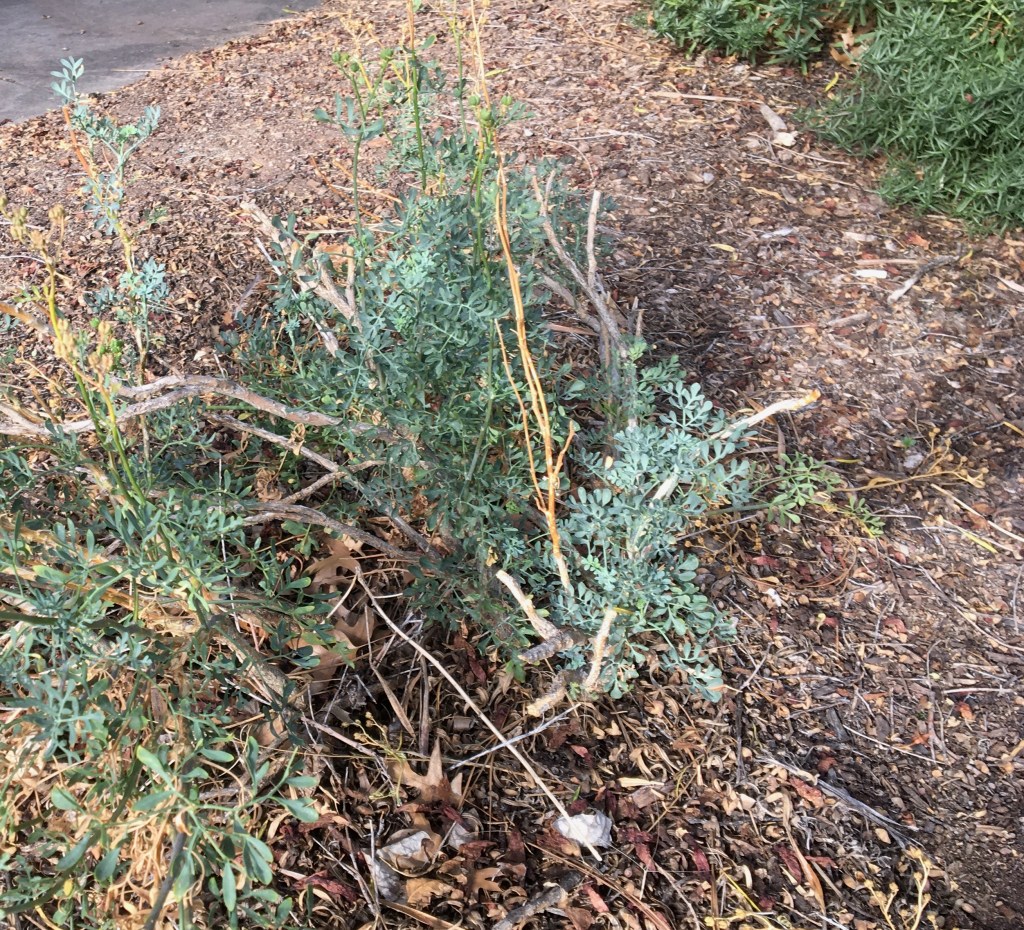
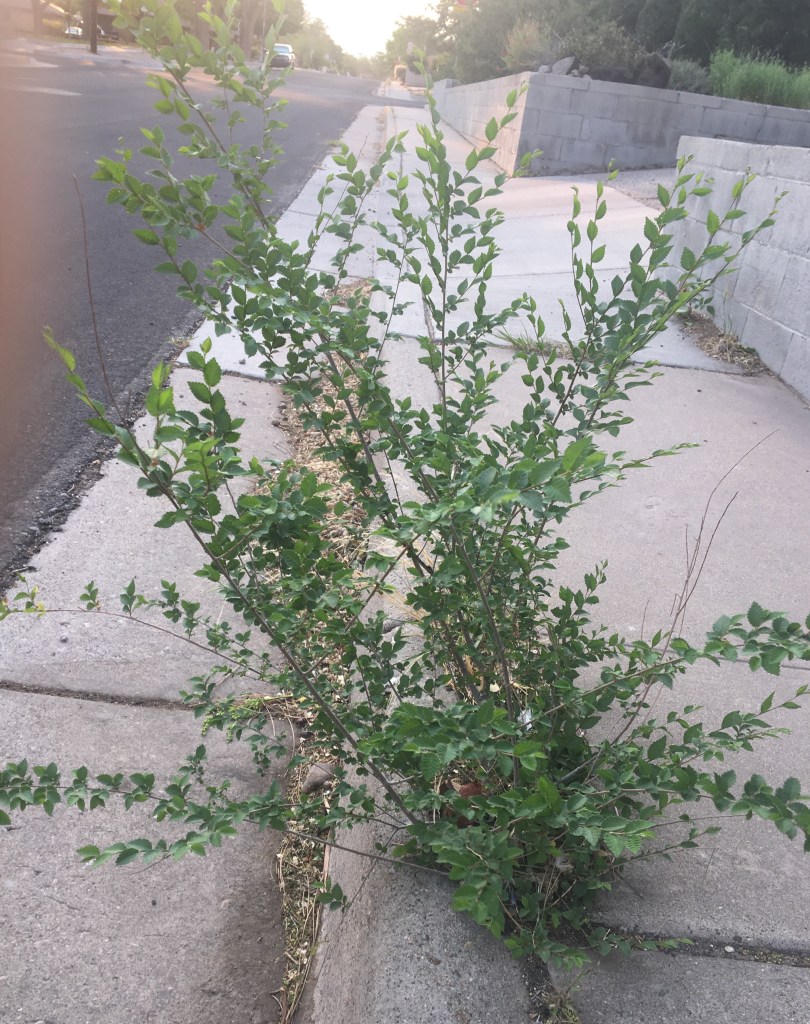
Weeds pop up in the most desolate of places, like between sidewalk and curb and in asphalt cracks. 

A week or two ago I spotted a sunflower growing out of a sidewalk, but couldn’t find it again. Probably a neatnik homeowner demolished it. Usually wild sunflowers pop up in our backyard, but this spring must have been too dry. 

My morning’s walk examining sidewalk cracks turned up nightshades; grasses; bindweed; an elm tree; amaranth; and a desert marigold (I think).

Some homeowners dump gravel on their bare yards. They don’t realize, besides the heat the gravel radiates, how much effort is required for upkeep. Wind-blown dirt and seeds imbed and rain brings up weeds from this most desolate of landscapes.

It reminds me of Alan Weisman’s fascinating book: The World Without Us, 2007. He says:

On the day after humans disappear, nature takes over and immediately begins cleaning house—or houses, that is. Cleans them right off the face of the Earth. They all go.”

Not only houses. Untended pavements can break up, allowing water to percolate back into the aquifer. Forests and grasslands can revert to their wildlife. Wouldn’t it be wonderful to see forests allowed to expand across the globe?

I don’t think I’d survive without peopleeeds

or: What will crop up this week?

A whole week of not writing (Covid didn’t leave me much brain). Sometimes I came up for air and saw all the neglected household tasks.. Other times, I buried myself in sidewalk crannies.

Now into a new week and a fresher brain, I’m watering my latest outside sprouts: eggplant, spinach, and nasturtiums, while waiting for seeds to sprout on paper. Weeding comes later.

Mother’s Day was cancelled

on account of COVID. My Covid started on Saturday. Even a light case, for someone who’s had two vaccinations and one booster, is not comfortable. 

And it gets even less comfortable when you know someone else is depending on your services and you don’t want to get out of bed.

Mother’s Day posies

So instead of a blog, I’m posting a picture of the glorious bulbs growing at the family “homestead” (the house where we grew up) which my sister owns.

She took the photo between rain showers in Washington—rain which New Mexico badly needs, being the forest fire hotspot of the nation so far this year.

Meanwhile, my spinach seeds are sprouting.

Be well, everyone.

Compost

The last two summers have been difficult ones for gardening, due to my inadequate planting medium (AKA dirt) and marauding squirrels eating my young plants. Consequently, back in March, I couldn’t bring myself to begin sprouting seeds.

But the weather warmed and a tomato plant called my name at the grocery store. It needed a cozy place to grow up.

Since last fall, I’ve been composting kitchen scraps. For the tomato plant, I topped off a dirt-filled tub with compost and planted it, sheltered by a wall o’ water. I also added a few cucumber seeds to climb the fence. Ooops!

Don’t get me wrong. Everyone was happy—especially the squash seeds that sprouted out of the compost! I weeded out most of it, but wanted to transplant some in a roomier container.

Which meant I needed more good dirt. I ordered a cubic yard (minimum order) of rich composted soil. That’s a lot of dirt! Especially when hauling it bucket by bucket.

At least this year the garden ought to grow. And no signs of squirrels! (Yet.)

Composting words

Writing requires composting too. Everything goes in to get decomposed, or do I mean re-composed? Research, dog walking, idle thoughts, listening to news, staring at the chalice flame during Zoom church services . . .

And if any unneeded seed-ideas pop up, I’ll try to save them for transplanting.

On Masks and Villains

I loved wearing a mask during the shutdown: A chance to not think about what expression my face was wearing. A chance to not display my crooked tooth.

In novel writing, villains wear masks of a different kind. The villain or antagonist, generally wants to hide less obvious flaws or desires.

Bath time. You don’t see me..

The villain of my trilogy poses as a rich man—which he is.  However his mask covers the many ways he plots his return to the good old days when his family controlled vast wealth and power. I’m afraid he’s too stuck in the past to change.

I’ve learned to pay attention to recurring thoughts. Lately, what keeps coming to mind is the antagonist in my retelling of The Goose Girl, which I’m not currently working on. (Maybe thats my next project?)

There’s a rule of thumb that the main character of a book is the character who changes the most. And I keep wondering, should this antagonist actually be the protagonist? Both female characters share a similar problem, but their reactions are polar opposites.

Maybe if I manage to remove the mask my antagonist wears, discover the hidden reasons behind her determination to take the place of the queen’s daughter, there will be—not a role reversal so much as—dueling protagonists. 

After all, no matter what a protagonist faces, their own self is often their biggest challenge.

What about you? Do you fight a villain outside yourself? Or inside?