Lost Anchors

For the past several days, I’ve been trying to identify a coherent theme for this week’s blog, This morning, a friend, her grief fresher than my own, said, “I feel like I’ve lost my anchor.” That was it exactly! 

She too had a husband with dementia, and had been making the decisions for them both. These last few years, every action not related to writing was directed towards keeping Wayne’s and my mutual boat afloat. The responsibilities came on gradually. I could feel them weighing more and more heavily, but each new load was something I could handle.

With Wayne’s death, I clung to the idea that at least I had a clear purpose—that of finishing my writing projects. And I had Sophie to take care of. But on Saturday, after buying groceries and walking Sophie, I felt in limbo. I had plenty to do, but no will to tackle anything. My boat that morning was anchorless and directionless.

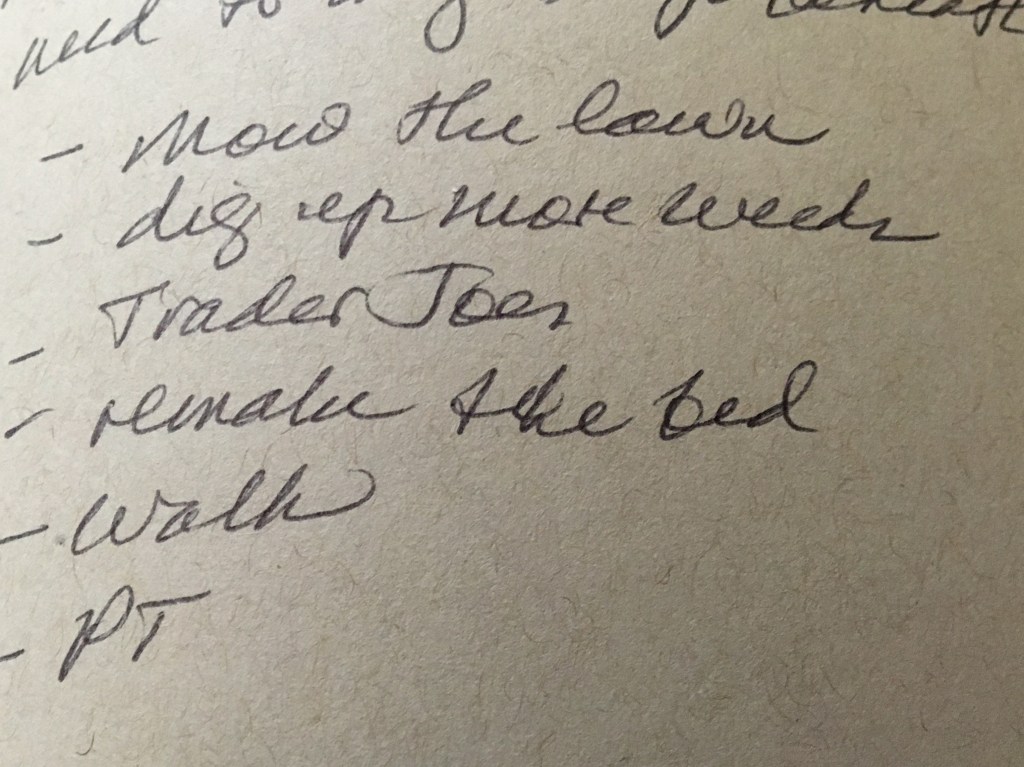
Along with that came a vague sense of anxiety. It was the anxiety that spurred me into action. I sat with a sudoku puzzle in a kind of meditative state and found a sense of inner quietude. Then I went to scrawl in my journal. After putting down my wayward thoughts, my hand went on to make a list:

Not only did I have my to-do list in hand, but I did them in that exact order, along with a few interruptions. I mowed, did a little weeding, made a quick trip to Trader Joes, changed my bed, took my walk . . . And finally at bedtime, ran through my physical therapy exercises.

This feels like it’s going to be a long siege of me against my own inertia. My only recourse is to stay in dialogue with myself. Either that or find a therapist, but the way I constantly delay taking action, journaling has to come first. Otherwise, how will I know what to do?

Who am I? seems to be a question that recurs over and over in a lifetime. I’m on a quest to see if I can get my boat propelled in the right direction.

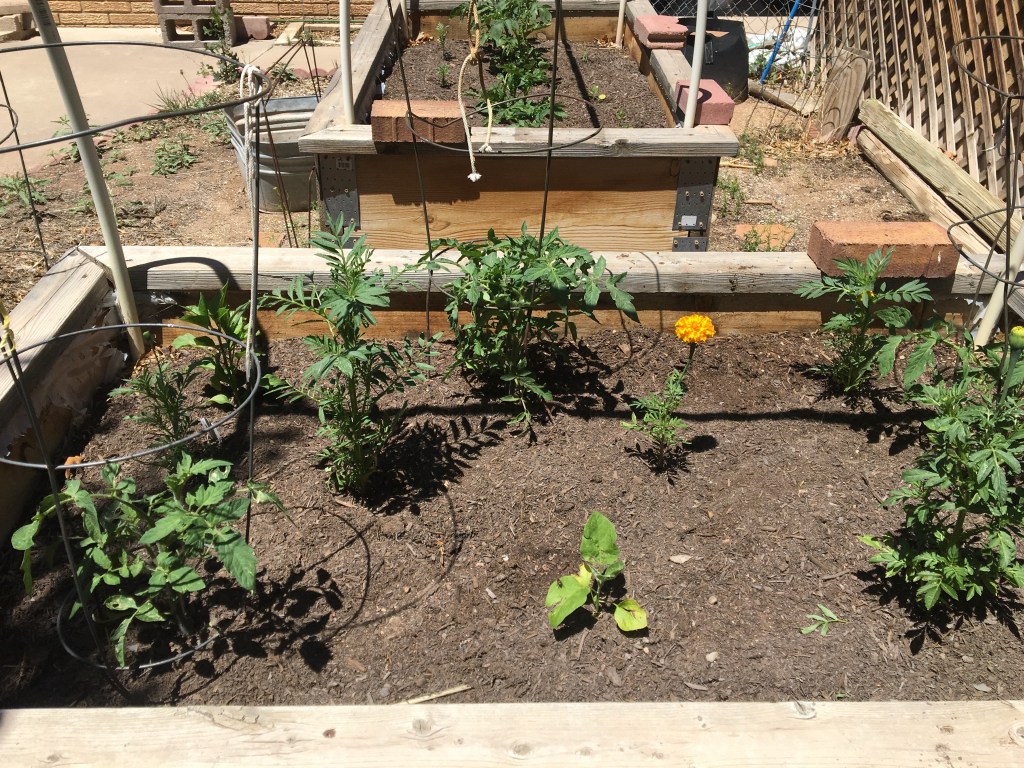
Meanwhile, the garden is thriving. Potatoes are in the foreground.

Escapes

I indulged myself last week—removed myself from time and space—especially time, since I blanked out an intended visit to a friend on Saturday and only remembered Sunday afternoon. I sent abject apologies, of course. Actually, I haven’t really stopped escaping now, simply slowed down. 

There was reason behind my reading binge. I called it research. The research part: How do mature teens behave, think, act, react? And, how do authors convey those same teens in action? 

But in truth, it was pure escape.

I browsed my iPad for the library’s holdings of young adult ebooks, and the name Louis Sachar caught my eye. I loved his Holes, and here was a title new to me, though published in 2010, The Cardturner, a book about duplicate bridge. I know little about playing bridge, other than Barry Rigal’s daily column on the newspaper puzzles page, and I only pay attention to that because of the quotes he inserts, which have nothing to do with the game (as far as I can tell). 

Reading The Cardturner was a lot like reading a book about a sport I don’t indulge in, where my interest is in who wins or loses, and what one learns about people by playing the game. Seventeen-year-old Alton gets the job of reading the cards to his blind, very rich great-uncle, who never forgets a hand. Family drama, romance, and even some channeling of ghosts add tension to the plot. 

The next title that caught my eye was Robyn Schneider’s The Beginning of Everything, 2013. This many-starred read is the opposite of a sports novel. Ezra’s accident puts an end to tennis and his place among the jocks. I’m definitely planning to re-read this one, being a person who is still wondering who I’m going to be when I grow up.

After those two, I read three other YA novels and am now reading a very old collection of Sharon Lee and Steve Miller’s shorts, Double Vision. 

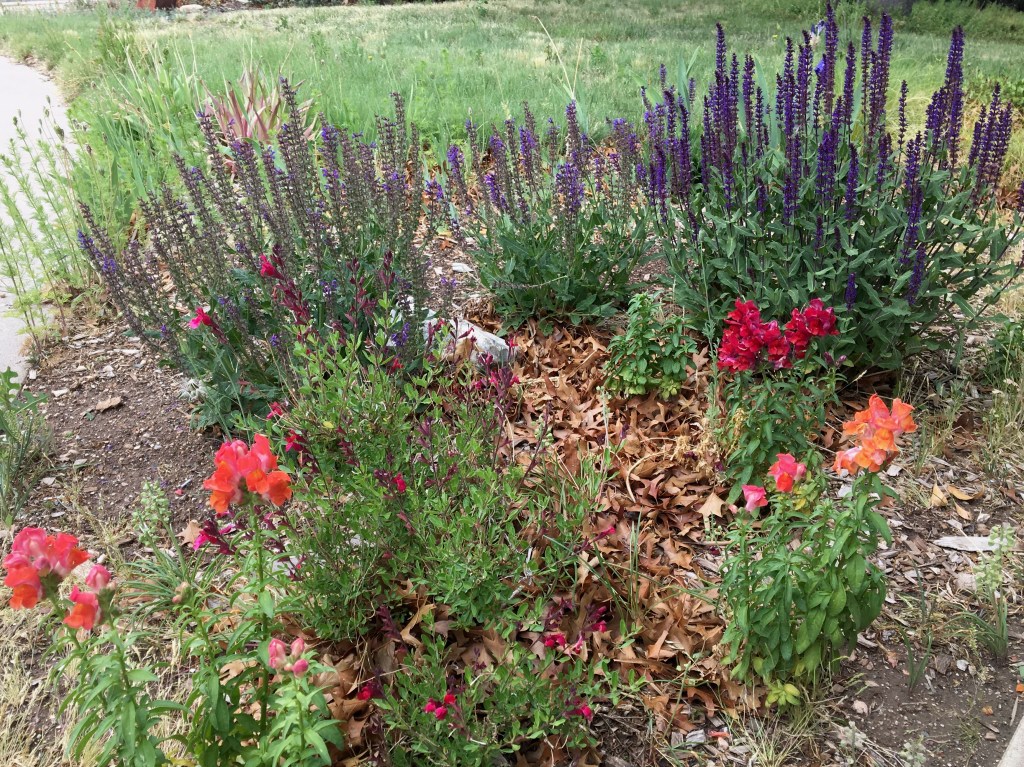
Flowers Sophie and I pass in the morning

And finally got back to work on my own visions. 

Walking Sophie this morning, I was reminded that any time a deadline presses on me, such as preparing for company or a trip, I first escape into other worlds. It always used to worry me, and I still don’t know the psychology behind it—but there it is, if anyone can explain it.

Adapting to new realities

My apricot tree rarely produces a bumper crop, but it does its best to produce at least a few fruits each year.

This year’s February and March were months of widely varying weather. The apricot’s first buds appeared at the beginning of March, what amazes me is that they continued to appear. Even now, with the tree fully leafed out, there are still some blossoms.

Do you suppose the tree is adapting to the vagaries of climate change? If so, what is it paying attention to? Weather? Pollinators? Moisture received?

I’ve done no scientific studies, never kept decent records of its blooming dates, nor compared weather to fruit production, but I do wonder if the tree is trying to hedge its bets this year. I’ll let you know how the fruiting turns out.

I, too, am adapting to new realities.

Early in her mourning period, one of the women in my grief group complained to her therapist that she couldn’t sleep. Her therapist asked what time she went to bed. “7:00 o’clock,” she answered. 

I never tried going to bed that early, not with a dog to attend to, but there’s more than one way of turning off one’s memories and emotions. This past year, I spent a lot of hours losing myself in murder mysteries on dvd or escaping into novels. 

But now, in my thirteenth month of widowhood, it seems the time has come to wake up. Those escape routes, especially dvd watching, have slowed down precipitously, though you never know when a book might snatch me away. 

And one more distraction has entered the picture. A trip to visit my daughter. Suddenly I have a deadline for cleaning up the yard, and on figuring out what to pack. An added plus is that the added activity is actually beneficial to my writing projects. And my sleep.

Deadlines! You’ve got to love them. 

Now, what are we going to do about climate change? 

Life—It’s all about the little things

Can’t ignore these guys.

Yes, I advise myself to stay calm. To breathe. To relax. But none of these are helpful when my real problem is feeling ignored and helpless.

In fact, for the first time since the switch to daylight savings, I got up early to join my coffee group to find real people to complain to.

My landline has been nonworking, nonviable, dead, for the last ten days. I called on Monday, ten days ago, and thought help was coming. Nothing happened. I called again on Thursday. 

This time I got a ticket number and a date—yesterday. So I stayed home all day, keeping my cell phone near, in case. Again nothing. Did I want to go through the same old computer system, repeating the same old problem, finding out there’s no record of my previous calls, and with NO HUMAN TO SPEAK TO?

No! I felt ignored. 

Certainly I didn’t want to talk to that same old computer again! So I had my tea with the coffee group and came home to walk Sophie. Since I was calmer, and had a little time before an appointment, I tried that “help” line one more time. 

This time the machine actually acknowledged that there was a damaged cable, and that it was being repaired. FINALLY!

Mea Culpa

We’re all guilty of tuning out the other guy sometimes. 

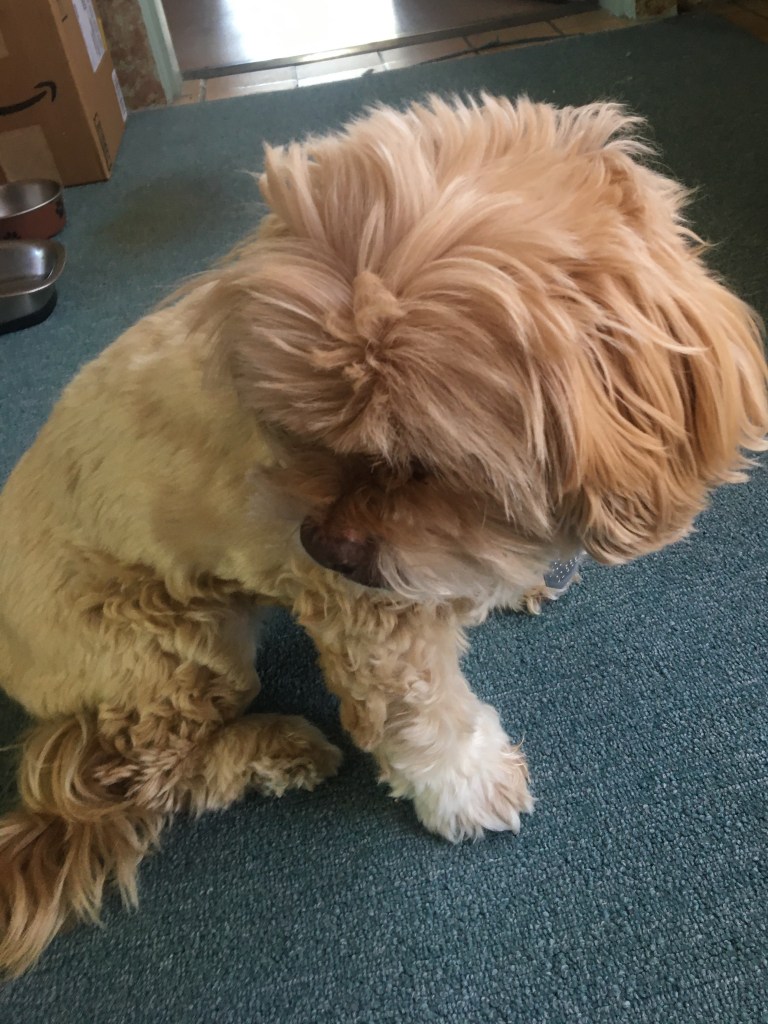
I don’t mean to ignore Sophie, but it does happen. She has to be lifted up and down from furniture, and her bones love soft spots. Last night, she was so quiet, I forgot she was on the sofa, and left the room. I began hearing soft complaints and went to her rescue. 

Even more than being comfortable, Sophie wants to be near me. No complaints there—except when I trip over her in the bathroom or hallway. That’s why each morning, I leave her sleeping on the bed and try to finish dressing before lifting her down. But on one unfortunate morning, I must have taken too long. She took matters into her own paws. 

I heard her slide off the bed. She joined me, seeming okay, but several days later she exhibited clear signs of being miserably in pain. I’m sure that impact was the cause of an arthritis flare up. After two days on pain killers, she was acting like the puppy she isn’t.

Nationally

Feeling ignored really is a biggie. It’s exactly why voters chose the candidate who sounded like he cared about their problems. I wonder when they’ll decide they’re the ones being ignored.

Pay attention, politicians. Ignore at your peril.

Serendipities

Another month gone. Already? 

I know, I know. The speed of time is all in our minds. The longer we live, the more we repeat actions like locking the car or driving to the store. Only new experiences slow down our perceptions.

But seeing time fly past accentuates the slowness of my writing progress. I want to finish this trilogy, but flogging my brain never works. Giving it all a rest often brings on an aha moment. One happened this past Monday, for instance, while taking a walk.

Scientific American’s March 2025 issue contains “The Wonder of Insight” (discussing our aha moments). In the same issue, “Thinking Without Words” answers the question, is language necessary for thought? Which it is not, animals of all kinds problem-solve, though language is excellent for passing on information. 

Then in the park’s library box, I found Malcolm Gladwell’s Blink, The Power of Thinking Without Thinking, and I’m half-way through it. His focus is how underlying expertise creates leaps of the mind. (Oh, if only I were an expert!)

As an aside, I love that every one of speculative fiction writer Kate Wilhelm’s novels reflect her fascination in the many ways the mind works. 

Coming across these related readings gives me a serendipitous feel, but mainly, they remind me of what I learned in a long ago workshop. Every unfinished task occupies a part of one’s mind. I recall at the time, having checked off a to-do list, my great sense of relief and freedom (not to mention surprise at the ease of dealing with long-postponed jobs). 

Hmm, I guess that means I’ve got to keep on weeding the yard. Maybe I’ll clear my mind for more insights while keeping active.

When Friends Show Up

I’m thinking of a phone call that came on a day I was feeling particularly glum. I like that word, meaning “gloomily sullen or silent,” from the Low German meaning “turbid, muddy”. That fits. To me, glumness holds vibes of living in a colorless world. This particular caller was also grieving losses, the first time we’d talked one-on-one. It was a lovely, lengthy chat. Afterwards, I felt much more alive, the world a brighter place. (I hope she did too.)

One thing I’ve discovered about glumness is it’s symptomatic of a suppression of feelings. For me, I suspect it’s a lifelong habit, but I am learning that our feelings are better served if they are recognized, no matter how sad or painful. Sadness is a reminder of a love shared, of a cause for gratitude. I am a different person because of my marriage.

Contacts with people move me to be more proactive. A recent sermon emphasized the need for self-care, even as we take action during these stressful times. Those Covid years made me even more of a homebody than normal, but it is past time to break out of my ingrained, in-walled, and unproductive routines. Sophie doesn’t really require me at her beck and call every minute—comfort creature that she is. 

One recent night, my mind was circling around a particular action (one of many I’ve been putting off), and the underlying message was Do it for yourself. So the very next day, I did. I took steps to get on a waiting list for possible future living quarters—sometime in the vague future, when I no longer have a dog. (And when I’ve downsized myself).

I’ve had book friends all my life, but downsizing includes letting go of some of them. I’ve successfully donated a number, mostly books with no emotional appeal. Some of my well-worn old friends have been waiting to go to the library box at the park. Since it doesn’t hold many books, I only take a few at a time from a batch waiting near the back door.

Last week I pulled out one tale to revisit— Maria Escapes. I spent the rest of the day re-reading and chuckling over the forgotten humor. No way could I feel glum while following this Victorian era orphan as she runs away from school. She ends up being tutored—and having escapades—with three neighboring brothers in Oxford, England. 

No, no, no! I can’t let Maria escape me. In fact, my wi-fi was down, so for two days I had no way to search out more books by Gillian Avery. Maria Escapes has proven her staying power. The British copyright was in 1957, and the U.S. edition occurred more than 30 years later, in 1992. 

Having returned Maria back to my own shelves, I then pulled out a couple other old friends from my giveaways . . .

Downsizing is going to take a while. As that old song says, 

Make new friends, but keep the old . . .

Blue

In her journals, Anne Morrow Lindbergh wrote about her grief in losing her first born child —the famous Lindbergh baby kidnapping. She spoke of focusing on high-reaching objects (I don’t remember specifically what) but I picture trees or mountains.

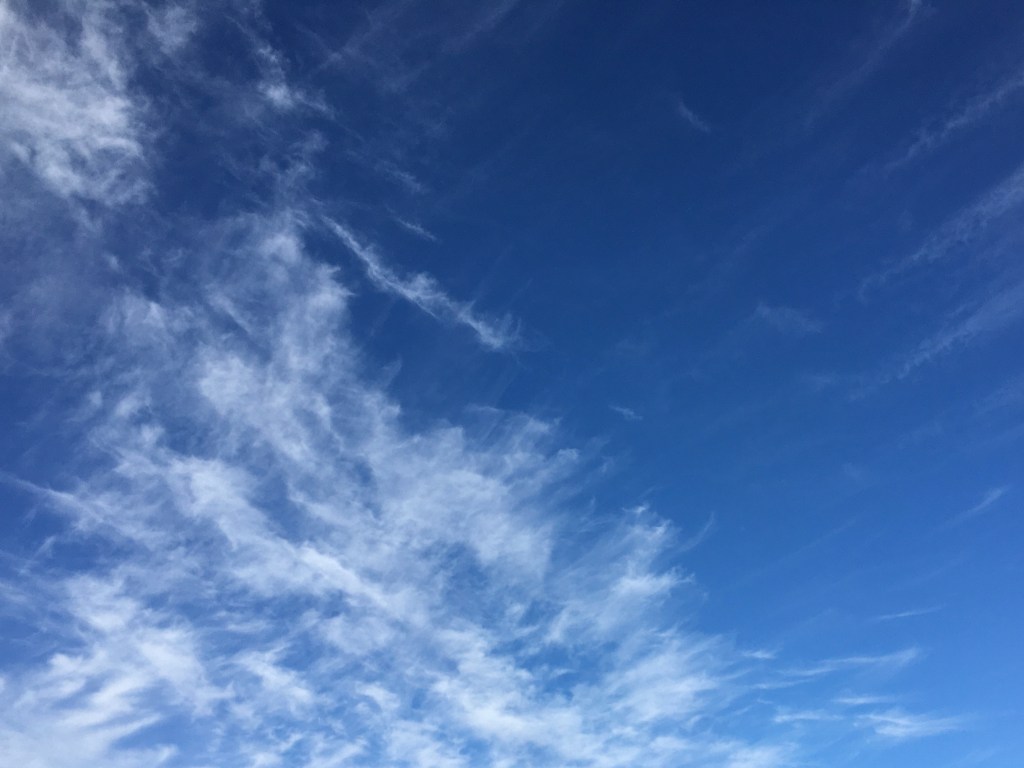
And in fact, I’ve done a lot of looking up this past year, but recently I realized it’s not so much the tall elms in the park as it is the sky beyond. That bluest of blue at the highest point of the sky, and it seems to take on an even greater intensity when contrasted with tree limbs.

Wayne had blue eyes. There was a time, back before we were a couple, when we were walking in a group. And he looked at me. I don’t know how to describe it, but there was a flash of blue, somewhere between us. I started collecting blues and eventually wrote a poem.


I love blue.

Once I saw a sky so blue
it was new to me.
I love blue.

Once in the Rio de los Frijoles
blue sparkled,
uncatchable blue.

Once your eyes flashed blue at me.
Long before you saw me,
I saw you.

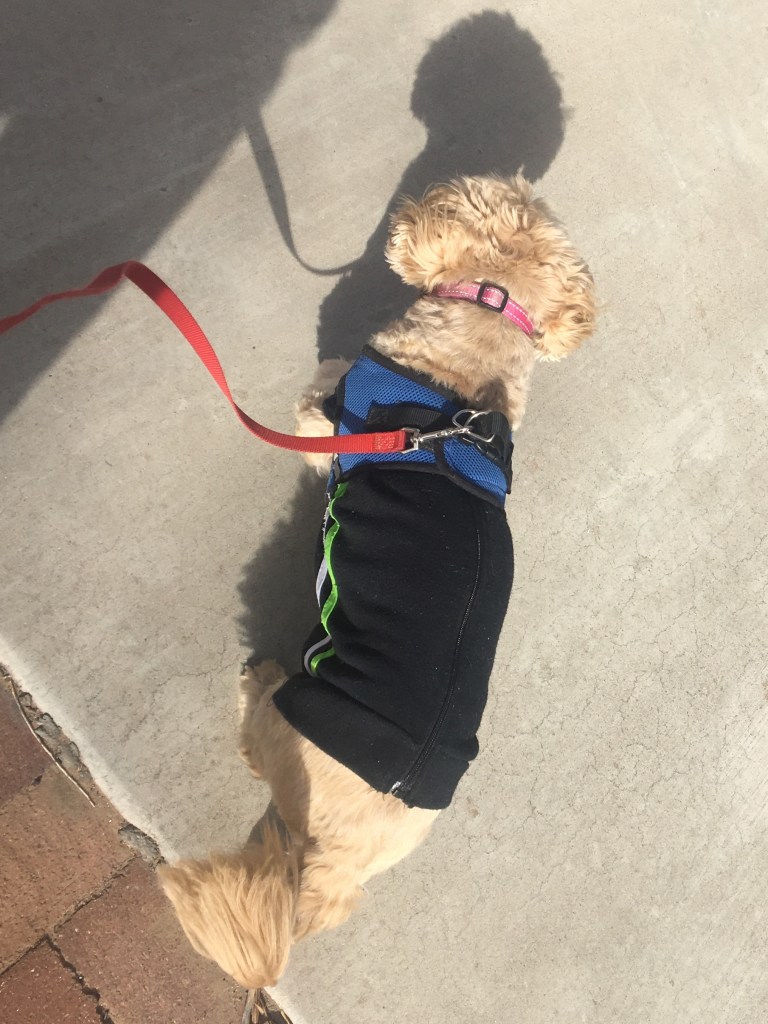
Since Sophie’s haircut, she has not objected to wearing a coat on chilly days, or in this week’s strong winds.

Pantsing or Outlining?

So. I’ve been writing a science fiction trilogy plus companion tale (It didn’t start out that way, but that’s how it’s ended up) for the last 50 years. I didn’t know where the story would take me, and it was only by self-publishing the beginnings that I could free myself to bring the whole shebang to a finish. Or rather, I’m working on the finish!

In one of my critique groups (I belong to two) we were discussing the benefits of outlining before writing. The biggest benefit is time savings. You know what you need to cover in a chapter, you know the goal of your current chapter, etc.

Yes, that’s all wonderful! But it implies you know where you’re going before putting pen to paper. And you know the theme of your story. So what happens if your mind doesn’t work like that? What if you don’t know what the story is about until you write it down?

I don’t always know what I’m thinking. Here’s a personal example. Quite some years ago, I went to urgent care with a relatively minor but uncomfortable matter and waited for a long time, while others were triaged ahead of me. 

Finally I dug out a pad of paper from my purse (always carry something to write on) and started scribbling. What did I write? I don’t remember, but my words pretty much told me to get up and go home. And I did. I went home and made an appointment. I often don’t know what I’m thinking unless I write it down,

That’s how my creative mind works as well. What comes out of my pen are conversations. It might be a dialogue between me and a character, or more often, it’s two or more characters talking among themselves. I’m merely their stenographer.

One of the critiques I’ve gotten has been a complaint that I include too much dialogue. That tells me I’ve done a poor job of translating “overheard” talk into proper scenes. There needs to be interiority, tension, action, decision making, not simply talk-talk.

I’ve arrived at the time for revision. I need to revisit my characters, especially the secondary ones, and bring out their stories a bit more. And I’m enthusiastic about doing it! It gets me up in the morning.

AFTER

That’s important. Be enthusiastic about whatever you’re living for. 

BEFORE

Sophie: Before and after. Just like in writing, there’s a before revision and an after. Let’s hope my edits make as impressive a change as Sophie’s haircut.

Retrieving what was lost

Lost Patterns. I never returned to my pre-Covid early morning walks to a coffee shop, that contemplative time for examining the writing day’s direction.

Nowadays, there’s a dog to feed. Other routines have erased thoughts of getting out on those predawn streets, like: eat breakfast now; page through the newspaper and do the NYT crossword, sudoku, Cryptoquip and Jumble puzzles; take the dog for a walk; and morning stuff, before I ever get to my desk.

Replacing Patterns. Meanwhile, I’m looking to create new routines. For instance, a way to overcome my laziness on Sundays is to wheel Sophie along on my walk. It offers a different slant to the same old routine, and hopefully Sophie enjoys it well enough—though she still walks the other direction when her carrier rolls out of the garage.

And this past Sunday I also hied me to the gym to ride the bike. That effort improved my attitude about coming home to do my PT—after a soft cone at Dairy Queen. Some rewards are necessary! While consuming ice cream, I jotted some notes, so it was time well spent.

Ongoing losses. I do try to remain hopeful for the future of our country—but a resolution will come with a great, and probably lengthy, struggle. 

Meanwhile, on the home front, I’m looking at the little losses, minor though they seem in comparison. With the one year anniversary of losing Wayne, I allowed myself to not do anything for a week. But that week grew longer, followed by a loss of writing momentum. Time to return to revisions. 

I had reconciled myself to being a year behind on finishing up the Pawn Quest trilogy, but yesterday’s critique session left me with a realization of just how much more revision remains to be done. 

Normally I love to revise, but when it comes to shaking up whole chapters, I’m going to need a clear focus and a great deal more imagination. Do I have it in me? I’ll let you know.

(Next week’s post—a discovery I made about Pantsers vs. Outliners.)

Seeds of Thought

The phrase “Grassroots Resistance” started me chewing over the idea of seeds. Seeds grow slowly.

Everyone enjoying the sun.

The vegetable and flower seeds I planted indoors may not all have sprouted yet, but all species now have representation, even the coleus that definitely prefers warmth and the reluctant (I don’t know why) eggplants. 

When the first seed of my sci-fi trilogy was planted so many years ago, I had no idea what it would become. The only questions it planted in my mind were Who? and Why? Who are these kids? and Why are they on that planet? The answers took years and years—and a lot of mind play, something to toy with while busy with kids and later with career.

What? and How? were the next questions. What was really going on? and How were they ever to get home again? That original seed evolved, needing a lot of cross-pollination and subsequent generations. Even now, I’m having to cull weeds to present a clear set of pictures leading up to the finale.

Then there are grassroots. My lawn of buffalo grass, planted by my husband in stages over three summers, holds the dirt down, helps soak up any water offerings from sky or sprinkler, and prevents weeds from overwhelming the yard.

Which brings us back to that original seed for this blog: 

Grassroots Resistance

the collective action from volunteers at the local level to implement change.

The mark of a good leader is to be out in front leading people where they really want to go. On the day of this writing, I noted two separate websites carrying the same message: 

People power is pushing at the leadership to act.

We’re all in this together. We are none of us DEI or we are all of us DEI, and I vote for the latter. 

We’re all human, of every size and color and origin and ability and sexual orientation. We are all one species. Together we can prevent the weedy spread of billionaires trying to take over our country for their own gain.

C’mon Congress! Wake up! Get with the real world of the people you represent! That goes for Republicans too.