Setting Goals

My earlier attempt to set a goal doing a little yoga every day fizzled out after little more than a week. I still do bits of yoga, but not regularly.

And then came the lost week of Covid when I did nothing at all. Well, hardly anything. The dishes got done. The clutter grew. Even our Roomba took a break.

It occurred to me that I needed to keep any goal setting within reason. Like do something within a week (rather than daily).

My dear friend Jane gifted us with an oximeter and a thermometer and they still sat on the living room table. The bathroom drawers were a cluttered mess. Why not sort out the bathroom and make space? 

Deadline one week.

I did it in three sessions. First, emptying out two drawers and one cupboard. Amazing the finds that were tossed. Second, checking all other bathroom crannies. Finally, the external room remained.

Saturday came around. Time was up. Armed with bucket and stepladder: 

  1. In the doorway, I worked out which direction was clockwise (because of all these cleaning articles that tell you to clean around a room in a clockwise direction to not miss anything). 
  2. I wiped down all cabinet doors, walls, mirror, window—in order, of course!—and ended up mopping the floor. 

Amazing how good that room felt afterwards. And the bonus was that all the bending and stretching had made a great yoga workout as well!

This week’s goal? In keeping to small steps, there’s this desk I know of. And on that desk is a box of papers left over from tax season. The week’s already half over and I’m still avoiding it . . .

First Squash Blossom

The Wonders of Weeds

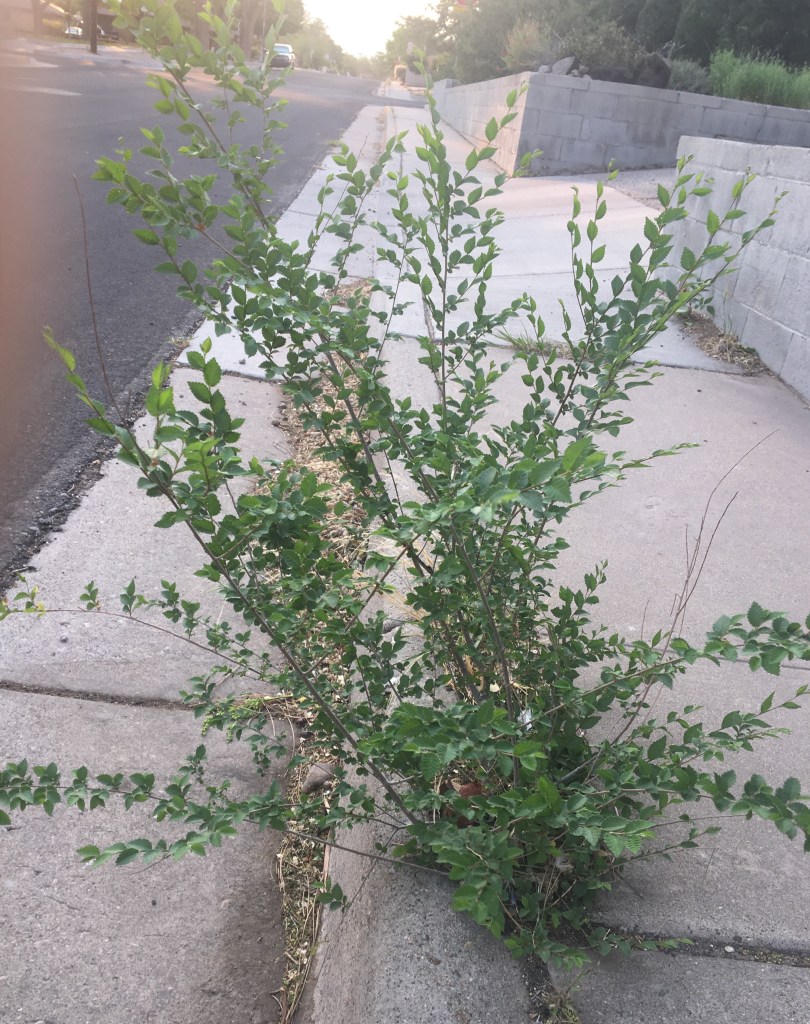
elm tree

Weeds pop up in the most desolate of places, like between sidewalk and curb and in asphalt cracks. 

A week or two ago I spotted a sunflower growing out of a sidewalk, but couldn’t find it again. Probably a neatnik homeowner demolished it. Usually wild sunflowers pop up in our backyard, but this spring must have been too dry. 

My morning’s walk examining sidewalk cracks turned up nightshades; grasses; bindweed; an elm tree; amaranth; and a desert marigold (I think).

Some homeowners dump gravel on their bare yards. They don’t realize, besides the heat the gravel radiates, how much effort is required for upkeep. Wind-blown dirt and seeds imbed and rain brings up weeds from this most desolate of landscapes.

It reminds me of Alan Weisman’s fascinating book: The World Without Us, 2007. He says:

On the day after humans disappear, nature takes over and immediately begins cleaning house—or houses, that is. Cleans them right off the face of the Earth. They all go.”

Not only houses. Untended pavements can break up, allowing water to percolate back into the aquifer. Forests and grasslands can revert to their wildlife. Wouldn’t it be wonderful to see forests allowed to expand across the globe?

I don’t think I’d survive without peopleeeds

or: What will crop up this week?

A whole week of not writing (Covid didn’t leave me much brain). Sometimes I came up for air and saw all the neglected household tasks.. Other times, I buried myself in sidewalk crannies.

Now into a new week and a fresher brain, I’m watering my latest outside sprouts: eggplant, spinach, and nasturtiums, while waiting for seeds to sprout on paper. Weeding comes later.

Mother’s Day was cancelled

on account of COVID. My Covid started on Saturday. Even a light case, for someone who’s had two vaccinations and one booster, is not comfortable. 

And it gets even less comfortable when you know someone else is depending on your services and you don’t want to get out of bed.

Mother’s Day posies

So instead of a blog, I’m posting a picture of the glorious bulbs growing at the family “homestead” (the house where we grew up) which my sister owns.

She took the photo between rain showers in Washington—rain which New Mexico badly needs, being the forest fire hotspot of the nation so far this year.

Meanwhile, my spinach seeds are sprouting.

Be well, everyone.

Compost

The last two summers have been difficult ones for gardening, due to my inadequate planting medium (AKA dirt) and marauding squirrels eating my young plants. Consequently, back in March, I couldn’t bring myself to begin sprouting seeds.

But the weather warmed and a tomato plant called my name at the grocery store. It needed a cozy place to grow up.

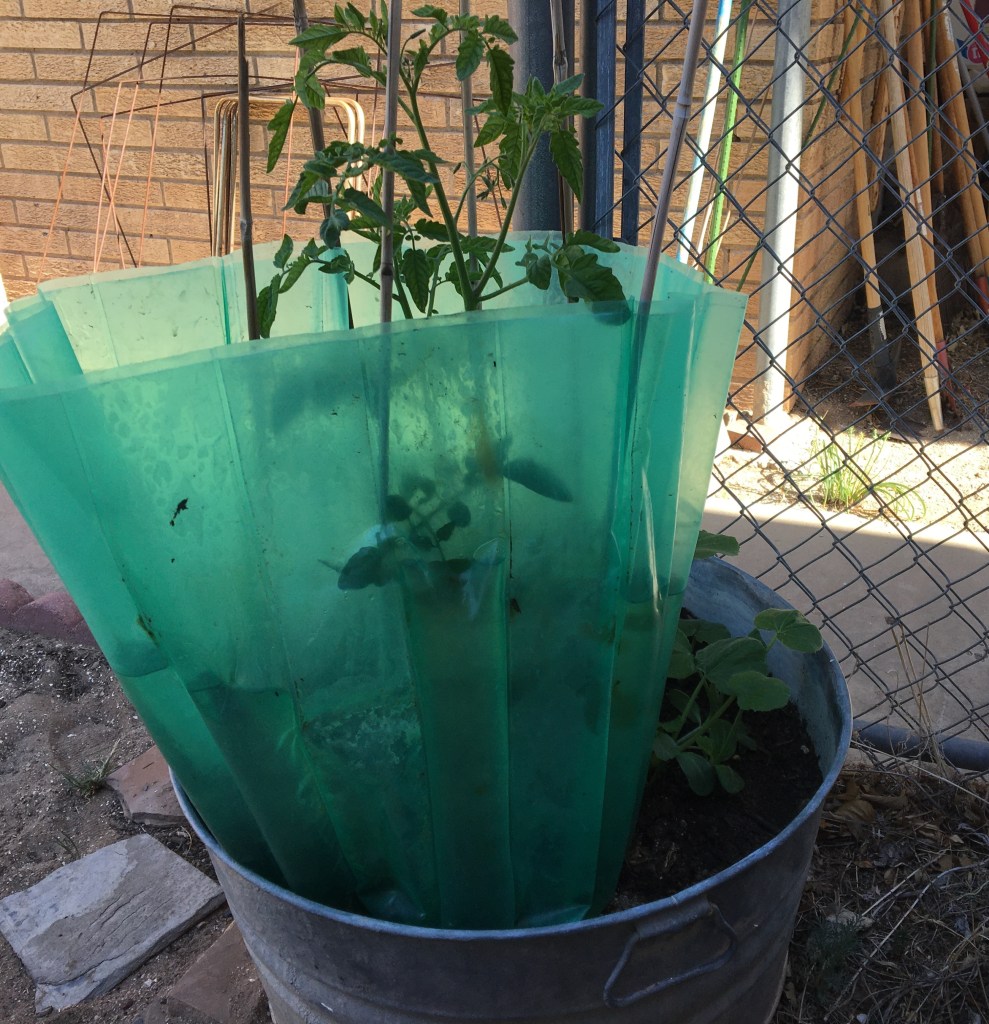
Since last fall, I’ve been composting kitchen scraps. For the tomato plant, I topped off a dirt-filled tub with compost and planted it, sheltered by a wall o’ water. I also added a few cucumber seeds to climb the fence. Ooops!

Don’t get me wrong. Everyone was happy—especially the squash seeds that sprouted out of the compost! I weeded out most of it, but wanted to transplant some in a roomier container.

Which meant I needed more good dirt. I ordered a cubic yard (minimum order) of rich composted soil. That’s a lot of dirt! Especially when hauling it bucket by bucket.

At least this year the garden ought to grow. And no signs of squirrels! (Yet.)

Composting words

Writing requires composting too. Everything goes in to get decomposed, or do I mean re-composed? Research, dog walking, idle thoughts, listening to news, staring at the chalice flame during Zoom church services . . .

And if any unneeded seed-ideas pop up, I’ll try to save them for transplanting.

On Masks and Villains

I loved wearing a mask during the shutdown: A chance to not think about what expression my face was wearing. A chance to not display my crooked tooth.

In novel writing, villains wear masks of a different kind. The villain or antagonist, generally wants to hide less obvious flaws or desires.

Bath time. You don’t see me..

The villain of my trilogy poses as a rich man—which he is.  However his mask covers the many ways he plots his return to the good old days when his family controlled vast wealth and power. I’m afraid he’s too stuck in the past to change.

I’ve learned to pay attention to recurring thoughts. Lately, what keeps coming to mind is the antagonist in my retelling of The Goose Girl, which I’m not currently working on. (Maybe thats my next project?)

There’s a rule of thumb that the main character of a book is the character who changes the most. And I keep wondering, should this antagonist actually be the protagonist? Both female characters share a similar problem, but their reactions are polar opposites.

Maybe if I manage to remove the mask my antagonist wears, discover the hidden reasons behind her determination to take the place of the queen’s daughter, there will be—not a role reversal so much as—dueling protagonists. 

After all, no matter what a protagonist faces, their own self is often their biggest challenge.

What about you? Do you fight a villain outside yourself? Or inside?

Welcome to chaos.

Chaos: “complete disorder and confusion

The world as we know it is coming to an end. We are in the midst of change. 

Those resisting thie change are digging in their heels and screaming “Whoa!” at the top of their lungs. That “Whoa” is revealing itself in laws attempting to control teachers, women, trans youth, voters, and more. 

So many of the new laws send me into a tailspin. I can’t fathom the venom directed at a few vulnerable trans kids, nor the eagerness of legislators to take control over women’s bodies. Every time I listen to the news, it gets more difficult to not despair. 

I want to scream that every human is different! Let us celebrate our differences, not fear them.

Daily I remind myself that these people in denial have already lost the struggle. They can make laws but the Pandora’s box of human differences has been opened and can never again be locked away.

Earth is the biggest loser. All the headlines are on Putin’s war. What is Putin in denial of? I wonder. How often does taking over another country actually succeed? I think never, in the long run.

Earth needs us right now. We’re falling farther and farther behind and allowing more permits to extract fossil fuels instead of pushing ahead with renewables.

What will it take to get us all lined up with a common concern for the future of our planet?

Books

When not writing, I’m  most often reading. And when most distressed, I read for escape. This past weekend (for the umpteenth time) I escaped into Patricia McKillip’s fantasy portrayal of the end of an age. The Riddle-Master of Hed, followed by Heir of Sea and Fire and Harpist in the Wind. McKillip too foresaw chaos and grief before achieving a new order.

To understand a Black experience, I highly recommend this memoir: I’m Possible, a story of survival, a tuba, and the small miracle of a big dream, by Richard Antoine White (2021). Dr. White is an Albuquerque resident.

***

Bookmarks! are free for the asking.

If you read my books, please consider leaving a review on Amazon or elsewhere.

Available in print or kindle.

Ty’s Choice, Middle Grade companion to Pawn Quest

Pawn Quest, book 1

Planet Quest, book 2

Discipline

Self-discipline is everything in novel writing. Or so I’m led to believe when friends call me disciplined. I call it obstinacy.

My mother called me obstinate long before I dreamed of creating stories. Actually, she called me that before I was old enough to get lost in a book. 

We are what we are, from our very beginnings. And a novel that turns into a trilogy? You’ve got to be obstinate to see it all the way through.

Does refusing to eat lima beans really equal writing novels?

Success breeds success?

Deciding to write a blog every week does require discipline. After succeeding five times in a row, I thought of a new challenge. Maybe I could devote a few minutes a day to yoga, something I’ve resisted for years.

If I can blog, how hard would it be to set aside 15 to 30 minutes for yoga? I’ve managed for a week. Though twice it’s been abbreviated at bedtime (or past).

The enemy to success

Writing and yoga bring with them variations on a common enemy: The busy mind

Before yoga, my mind says: “You’re going to turn me off? Don’t make me leave this book / this DVD / this crossword / this [you choose],” like a toddler fighting nap- or bed-time.

Writing is a little different. My mind likes to be busy when writing, but if it’s already occupied, it groans. “Don’t make me change!

A busy mind is good for revising but doesn’t bring about story breakthroughs. That requires an almost yoga-like mind. That’s why I love to lie abed in the morning, waiting to see what will rise to the surface.

Sophie can be very obstinate on our walks. Her mind is tied up with her nose. Mostly I let her have her own way—unless it’s something she thinks yummy or I have a blog deadline.

My books

I first met the main character of my trilogy many years ago in a vision of teens on a strange planet. I had no idea of who or why or where, but I was hooked on the mystery of it all. It’s taken years to find out why they were there.

Pawn Quest  leads up to that planet scene. Planet Quest explains what they found there. Now my mind (both busily and quietly) is intent on getting them home again—if I can.

More Thoughts About Change

I miss my weekly yoga classes. I attended them for more than twenty years, but during Covid, the studio closed down, they sold the props, they sold the building. Caput! No more yoga classes near home.

I’m thinking about exercising self-discipline and practicing at home. But it won’t be the same.

In a world undergoing change, we have to expect losses. And though we pick up the pieces, they don’t fit back together the way they were before.

Sophie

Where’s the cat?

Sophie gets an excited pitch to her voice when she spots a cat. Last night I let her out, thinking she’d stop at our sidewalk. Instead, she tore across the street. After she returned, I took time to enjoy a coral red sky.

Sunsets are change. Change can be beautiful. Is there anything in our lives that isn’t undergoing change?

Writing

Writers are told that the main character should undergo the greatest amount of change in the course of the story. I write novels because short stories are too short. My characters need to react and change at their own speed.

At a conference for children’s writers, a panelist declared that YA novels deal with coming of age, but Middle Grade books change the world. (I may have remembered wrong, but that’s what stuck with me.)

I kept world changing in mind as I wrote TY’S CHOICE. Ten-year-old Ty lives hidden beneath a future Dodge City, Kansas, where everyone has an implanted ID chip. Everyone, that is, except Ty’s people. The adults in Ty’s life are not looking for change. They’d rather remain hidden than take on that huge risk.

What kind of change do you want to see in the world?

What must happen to bring it about?

Changes

In the space of a week—the first week of spring—we woke to the beautiful results of a gentle snowstorm coating all trees and lawns. But by the end of that week our thermometers reached 82 degrees.

It’s very early in the year for Sophie to be too hot—but she is. She has begun refusing her afternoon walks, preferring to wait till closer to evening.

Changeable Climate

How can we know so much about climate change, how can we know how fast it is approaching, and yet our every effort to adapt moves so slowly? We badly need our communities united behind reducing greenhouse gases.

As a writer of science fiction

I took climate change into consideration when portraying future Dodge City, Kansas, which is the setting of Pawn Quest and its companion novel Ty’s Choice.

I had to make an educated guess to portray an imagined future on the other side of climate change: The recycling of everything. Energy-producing buildings maintaining integrated water systems. The division of lands between humans and wildlife to provide plants and animals the space and migratory corridors needed for adaptation and evolution.

Change is difficult, and the change we must embrace to combat global warming is going to be a one-way trip. I hope we can get it right. 

A conversation about change

Writing novels is a way of carrying on a conversation. Though there are many nonfiction children’s books on the topic of the environment, I’m looking for fiction. If you know of any good children’s fiction dealing with the climate, please let me know by email or in the comments.

A good book—

Though not about climate change, a children’s fantasy I read recently caused me to sit up and take notice. I highly recommend The Ogress and the Orphans, by Newbery Award winning author Kelly Barnhill.

The villagers are so sure they know the truth that none will listen to the orphans. The situation is so much like our current information divide that I had to keep reading to find out how it was resolved.

I next read Kelly Barnhill’s award winner, The Girl Who Drank the Moon. I love how the author reaches deep into the hearts of all her characters.

In Praise of Play

One time when in the middle of writing a novel, I got stuck. I didn’t know how I was going to proceed. And with a full-time job, I had only a half-hour in the mornings to write.

My solution was to put a calligraphy class to use by filling a small notebook with italic handwriting. For text, what I wrote became a mythological background to that fairy tale I was reimagining. And eventually I reached the end of that first draft.

Calligraphy for me is not work but play. I don’t expect to ever have a perfect script. My ego is not bound up in it. Play feeds creativity.

When Dogs Play

Sophie is most often playful after a meal. She’ll grab a toy and make it squeak. Or she’ll tease Wayne by coming to me while he’s trying to get her harnessed for their evening walk. 

Sophie/Rooney

When my sisters came to visit last fall, one brought her dog, Rooney. Sophie and Rooney ignored each other most of the time. But after a meal, Sophie would be ready to spar with Rooney. Then they’d return to their napping.

Creativity Needs to be Fed

Play makes a good meal for the creative side of the brain. My Muse needs a quiet mind to work with. Revising my verse novel often feels like play, but usually I silence my busy mind by relaxing with book or DVD. Or a long walk. Or my tai chi class.

Years ago, I realized I would never be able to write for a living. Work under pressure?  Panic! Fear! Desperation! Nope, nope, nope. I needed a regular job, thank you very much. 

But a few weeks back, I set myself a goal of writing a blog every Sunday to be published on Wednesdays.

Ooops. Here comes that pressure again!

So, can anybody tell me how to turn a weekly goal into something fun?