A Bumpy Ride through the holidays

Some of us have it easy.

For weeks, dreading this holiday season, I’ve watched myself escape into anything other than the present. Consequently, with these special days looming, I worried about my ability to take care of what needed to be done.

In the immediate past (like two weeks), I’ve started most days with five minutes of meditation. The idea is to keep myself present—at least, present to whatever duty requires my presence. No way am I going to totally disavow escapism as a way of life, since it’s been a part of me, lo these many years.

Sunday’s weekly brunch for my sons came together as planned.

Monday, I feared missing out on my swim session without repeated reminders. Instead, I told myself all would be well, that I would remember, thus freeing my mind to really pitch into what had to be done.

What an amazing day Monday turned out to be. I had two boxes to send, probably on Tuesday. But before completing my daughter’s package, I had to finish a project begun weeks ago, then set aside. A good thing I’d eaten a large breakfast. I went to work.

The project was revised, printed out, and packed—in fact, both boxes were packed and sealed—with still time to swim before the pool closed. Immediately following my swim, I stood in line at the post office to mail the packages, drove to the credit union to take care of three matters, on to the library to drop off three books and pick up one hold, and finally back home to a mid-afternoon lunch. 

Yay, me! I took the rest of the day off.

Most of Tuesday was spent avoiding the idea of tackling Christmas cards, but in the evening, I completed the first two. It would be more time-efficient to write a general letter to insert in each, but since I couldn’t bring myself to do that this year, each letter is getting its own handwritten note.

This morning has been devoted to more cards. And finally, to write up this blog. The lesson is: We can do what we must.

Holidays are good

Deadlines are invaluable.

So, how about that little matter of Global Warming? 

Second Year Blues

The long shadows of winter’s approach

I’ve always been rather low-key when dealing with holidays. For instance, in the winter, I prefer the soft warm glow of a Christmas Eve luminaria display over a month of electric glare.

But I didn’t expect the whammy that this year brought—even before Thanksgiving. Last year, my loss was fresh, still front-and-center in my attention. And I was in a grief group. We had few expectations beyond acknowledging the holes in our lives, and any rituals we wanted to incorporate.

In this second year, my attention has moved outward—somewhat. I took two trips. I worked on the opus. I contemplated the future. 

And then (as noted in my previous blog), my manuscript went to a copyeditor. My last anchor was gone. Ignoring other projects I went AWOL. Why?

Something was nagging at me that I didn’t want to pay attention to. 

Two years ago, Wayne was visibly declining during our last Thanksgiving and our last Christmas. The coming holidays loomed. It took weeks to recognize that by escape reading and DVDs, I had cut out everything but meals, dog care, and any unwelcome demands on my calendar. 

Mention of an early Friday morning meditation group caught my ear. My mind went ping! and I set an intention to join them. 

Experts all agree that meditation is healthy. That doesn’t mean it’s easy. That’s why I prefer sitting in a group, where expectations hold me in place. After fifty minutes of silence (in two 25 minute segments), I felt awake, alert, ready to face the day’s needs. 

Since then, I’ve taken a few minutes to sit in silence each morning, feet anchored on the floor, back straight, while I tell myself to be mindful during the day. Five minutes fly past, and I get up to do my PT.

It is what it is.

Understand—it’s not comfortable paying attention to old sorrows—but if I willingly enter into my feelings, they fade. They’ll return again, but experiencing those waves of sadness are preferable to shutting out the whole world just to avoid them. I need people and grounding in reality.

We’re not all alike. There are many kinds of avoidance. For instance, the hero of my sci fi novels throws himself into work. I will always enjoy escaping into fictional worlds, but within limits. I don’t need to do so at an addiction level.

How do you handle your losses and grief? 

After a Long Silence

It has been a beautiful fall, with trees holding their leaves. We had several near or at freezing nights and finally, yesterday morning, a harder freeze. True to their nature, the mulberry trees began their drip drip drip of big leaves piling up beneath trees and on nearby sidewalks. Walking Sophie, I had to lead the way, kicking leaves aside for my small plodder.

I too have been waiting—not for a freeze but for change from feeling frozen in time and space. I haven’t blogged in six weeks and at first couldn’t understand why. Still don’t, actually. It’s all theory.

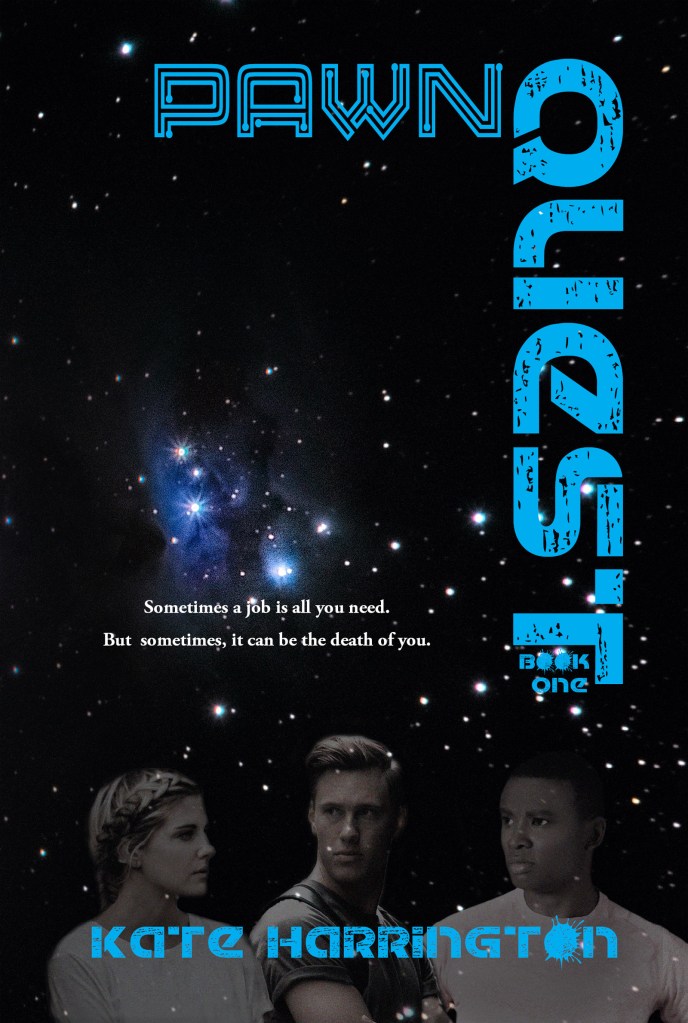
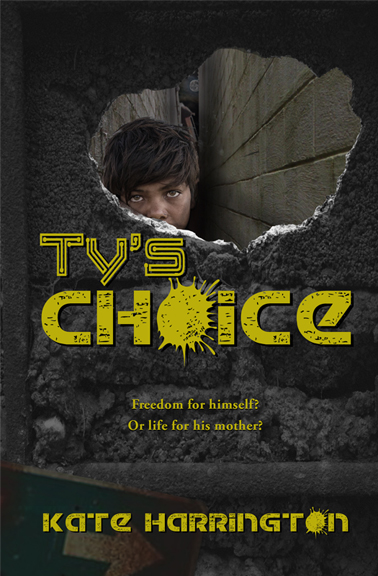
I was working hard to bring my manuscript to a sense of completion before sending it off to my new copyeditor, but even before that, I felt its loss. Fifty years ago—as my daughter crawled around—I typed up an idea featuring a boy standing on a strange planet. That idea has kept me company over the years as I explored my characters’ world: ((Pawn Quest, Ty’s Choice), and what happened when they arrived on that planet: (Planet Quest). 

Finally, finally, we’re nearing the end: (Quantum Quest).

Letting Go is Hard!

In bringing my heroes’ journey to a close, it never occurred to me that I’d experience this sense of loss, this great hole. There will still be additions, amendments, and the slog of preparing to book for publication, but this pause is a harbinger of the future.

Unable to bring myself to blog or tackle other projects, I turned to watching DVD murder mysteries and reading book trilogies.

Pari Thomson’s three Greenwild books begin with The World Behind the Door. Along with Daisy, we discover the magical areas protecting plants and creatures that have been lost in the gray areas of Earth. But even those special hidden spots are threatened by the Grim Reapers who somehow have found their way into the Greenwild. 

The other trilogy I gobbled down is a set of worn paperbacks, read countless times over the years. Beginning with The Riddle-Master of Hed, I once again dived into Patricia McKillip’s gorgeous prose. The High One’s realm is an orderly one, but Morgon, Prince of Hed discovers there are more riddles than his riddle-master teachers ever taught him. Ancient Earth Masters now threaten the balance of landlaw. McKillip was writing during the 1970s, during the nuclear arms race.

In my Pawn Quest books, I leaped over the Global Warming crisis to take a hopeful look at the other side. But whether the threat is Earth Masters or Grim Reapers or corporate greed, the underlying metaphor remains the same in all these books. 

Power always seeks itself. No matter who controls that power, it must be balanced by love, love of the whole, love for all peoples and species, for the sake of Earth’s health (and our own).

DIY Deadlines

I envy people with editors and publishers and deadlines. This DIY business of writing lacks a certain kick-in-the-pants to facilitate inspiration.

A writer can get too close to her writings. Somehow this week I’ve achieved a more distant view. So what went before to bring that about?

First: A response from my copy-editor who returned the first ten pages with her notations and comments. Second: A weekend visit to a children’s book fair (as attendee, not as a presenter). And Third, preceding the other two items: A course on selling books.

Monday night I worked late adding an additional scene for the last section and a bit on the epilogue. Both still need more work. Tuesday morning while walking, my thoughts turned to what I would say if I were presenting a book talk. And on today’s walk, I came up with a further topic to booktalk, plus a way to repair a minor problem in those first ten pages referenced above.

Wow!

What Ifs

This morning’s “book talk” idea revolved around the What Ifs that shape one aspect of my novels. What if future peoples are chipped at birth?

Imagine! No more ID thefts of social security numbers or bank accounts. Those implanted chips would hold name, birth, DNA, etc.

But, what if a foster kid doesn’t have that info on his chip? What if he doesn’t know anything about his origins, and won’t know until he reaches the age of 18? That’s one of the What Ifs of Pawn Quest.

And then we turn that assumption on its head. Our current and long-standing immigration policies made me realize there would always be exceptions. What if people who are not chipped have a baby? They can’t use the public medical facilities and they live in hiding. 

A very bright young kid appeared in Pawn Quest and demanded his own story be told. Ty’s Choice was actually the easiest book for me to write because there was only a single point of view—and the topic of implanted chips is very much front and center in the plot.

Maybe I should take more walks. A good thing our days are cooling down. 

How about you? Will I see you rallying on No Kings Day?

Remnants of a cruise—Exercise

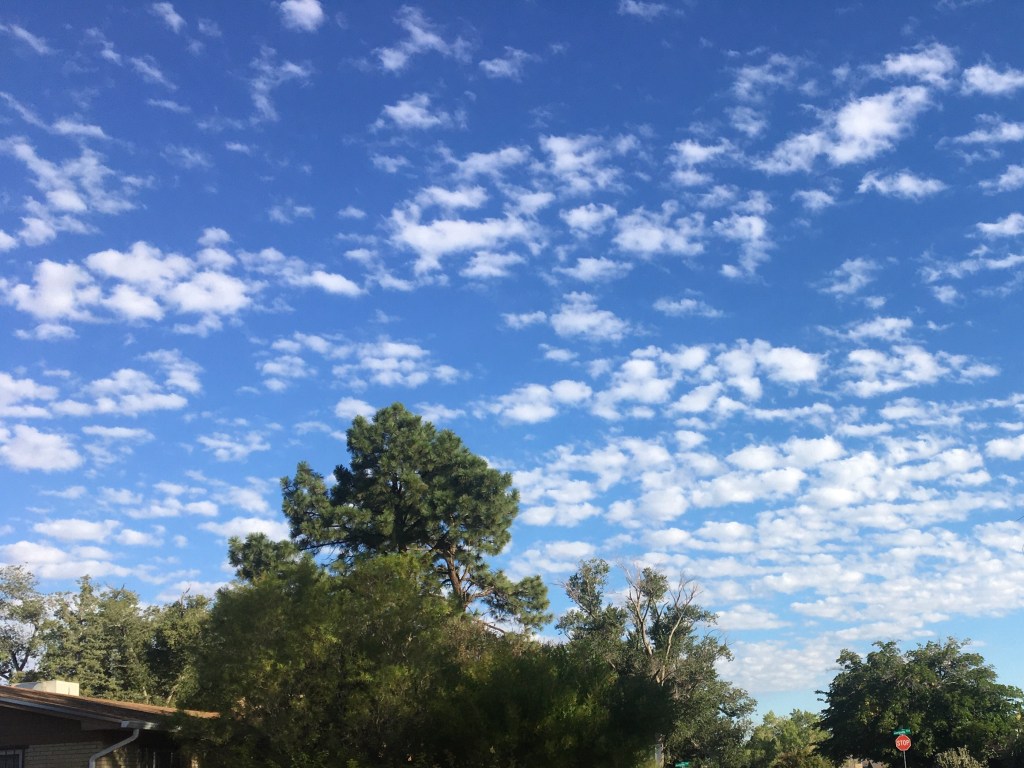
A recent early morning sky

I used to swim once a week. That was back before COVID. At some point, I always felt cold. For a time, I toyed with the idea of swimming in a nice warm therapy pool, but never acted on it. Anyway, I haven’t swum in years. The thought of it turned me cold. 

But exercise is necessary to keep the body healthy. I found a way to get me to the gym each week—by linking it with a grocery trip. That was so successful, I thought I might move on to another break-out idea—like swimming. But nothing happened. I just couldn’t push myself out the door.

That’s where the cruise comes in. The time away from home made a complete break from my old routine. One day, we went up to try out the hot tub and pool. After all, I’d brought my suit. Why waste it? The hot tub was lovely, and the pool was warm and inviting. I swam across it two or three times, and thought: I really could continue this at home! 

So back at home, I pondered my schedule and chose Mondays to swim—and then wondered if I’d actually carry out the plan. 

Even that Monday morning, I was still wondering. But I packed a towel, and got myself out the door. 

And serendipity struck!

The pool had been recently closed. Its usual denizens had not gotten the word of its reopening. Some people were leaving as I arrived, but only one other person was swimming—in that big pool where I’d worried about finding a free lane.

The body doesn’t forget how to swim, but wow, was I out of shape. This city pool is so much bigger than that warm little pool on the ship, I thought I’d never reach the other side. Oof! 

I managed four laps that first time, if a lap means there-and-back-again. The water was warm enough. What had I been afraid of? Maybe something has changed with my body since those COVID years.

That was last week. This week had scheduling difficulties for Monday and Tuesday. Today I didn’t let myself think about it. I did my morning revisions, and when the time came, I got myself to the pool.

Much more crowded today, but I managed five laps.

Swimming is a full body exercise and has got to be good for brain power—of which I feel a great need. I have a lot of learning in the days ahead—as I get this final volume of my science fiction trilogy ready to publicize and publish.

Maybe I’ll start swimming twice a week. Or more! After all, I paid for a year’s pass to any city pool.

How do you keep in shape?

Remnants of a Cruise—Books

I like meditative walks, walks that allow thoughts to surface. Walking with Sophie—when she plods slowly along without too many stops—can be very satisfying. 

Now that we’ve entered the cooling season, she’s more willing to take an evening walk around the block, and thoughts of my blog crept in. The hodge-podge of ideas left me wondering how I could find a unifying theme. I like a theme, it makes me feel like I’m chatting with a purpose, somehow.

Because I’m only two weeks back from a cruise, I am connecting with that break from my ordinary life, and how it is bringing change.

Our ship had a library and we had plenty of time for reading. At home I might gulp down a light novel, but nonfiction reading—like my Scientific American issues—often wait a long time for me to finish them.

In the ship’s library I discovered, among the books donated by previous passengers, The Accidental President; Harry S. Truman and the Four Months That Changed the World, by A. J. Baime (2017). It was exactly the book I hadn’t known I wanted to read.

Baime brings those first four months following FDR’s death into four-dimensional clarity and complexity, amazing me with how much happened in that short time, to be handled by a former VP who hadn’t been brought up to speed on anything—certainly not the bomb! I spend four or five days reading and interrupting my sister’s reading with comments. Truman, with no college degree but the ability to work extremely hard, saw the United Nations take shape, learned about the atomic bomb, dealt with world leaders, the origins of the cold war, and so much more. Then I left the book behind for the next passenger to discover.

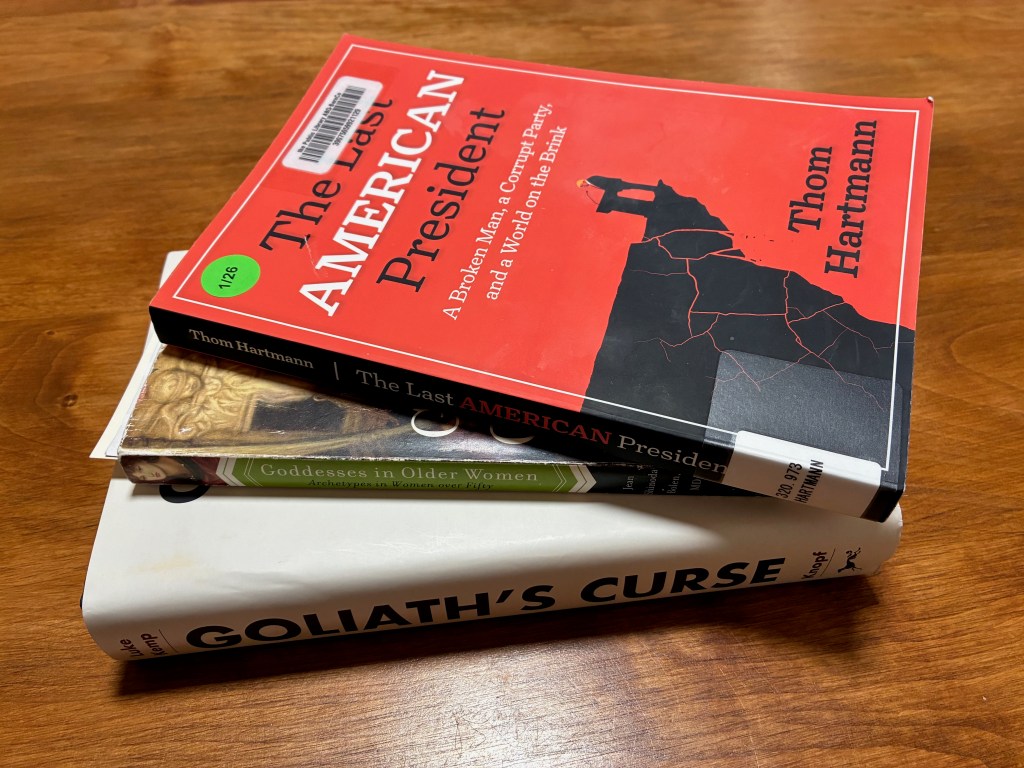
Lessons in Chemistry by Bonnie Garmus was recommended to us by our table mates on the cruise. Back home, my sister read it first. I had placed a hold on an ebook copy, but her comments over the phone pushed me to grab the more readily available print edition. Then I couldn’t put it down. Well, I had to put it down several times but sure didn’t want to! I finished it that same day, laughing out loud when I least expected to be amused.

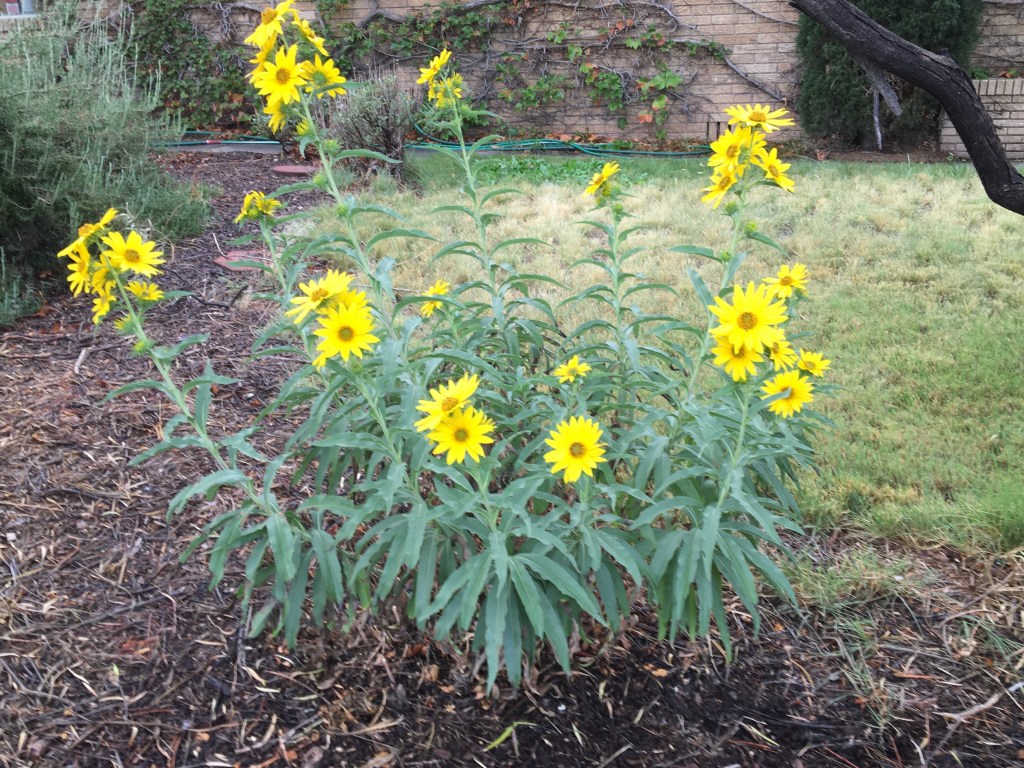
Maximilian Daisies welcoming in the fall

On the garden front, I came home to find more and larger green tomatoes than grew in the spring, and more eggplants—small but prolific. Plus, my solitary jalapeno plant has finally begun fruiting.

Next week, I’ll continue with Remnants of a Cruise—Exercise.

What are you reading? 

Notes from a harried writer

A glimpse of an Amsterdam canal

Ah, the hats we wear! 

I came back from our trip all fired up to begin the final revisions before a (as yet undetermined but imminent) deadline with a copyeditor. 

Before leaving home, I had sent out the remaining 80 pages (minus the epilogue) to my critique group. On my return, the first person to offer comments gave praise but noted my failure to mention the melodrama one of my characters has been playing with.

Writer’s beret

I too have been concerned about failing to include the melodrama, but hadn’t figured out how to present it. Her comment pushed my brain into a new direction—I could squeeze bits and pieces of melodrama into the unfinished epilogue, thereby giving it life without having to create the whole.

All of a sudden, I was wearing my “writer’s beret” instead of my “revision helmet.” Nothing very polished yet in these first scribbles, but they make a start.

Revision helmet.

Once that writing surge ended, I was back to making notes of all the missing touches to look for in a read-through of the whole:  items that ground the tale in place—Senses and Actions—as well as Holes in the narrative and Redundancies.

Of course, I’ve gone over and over my writings, but plead guilty of nit-picking while being blind to bigger issues. So this time, I’m reading carefully but not changing the copy, while hand-writing notes to myself.

My Plans. Didn’t someone once say Plans are made to be changed?

Once I’ve completed this read-through, I want to move the WIP into a new font and spacing, and then go through a second on-screen reading, in-putting changes, and simultaneously seeing the whole with fresh eyes.

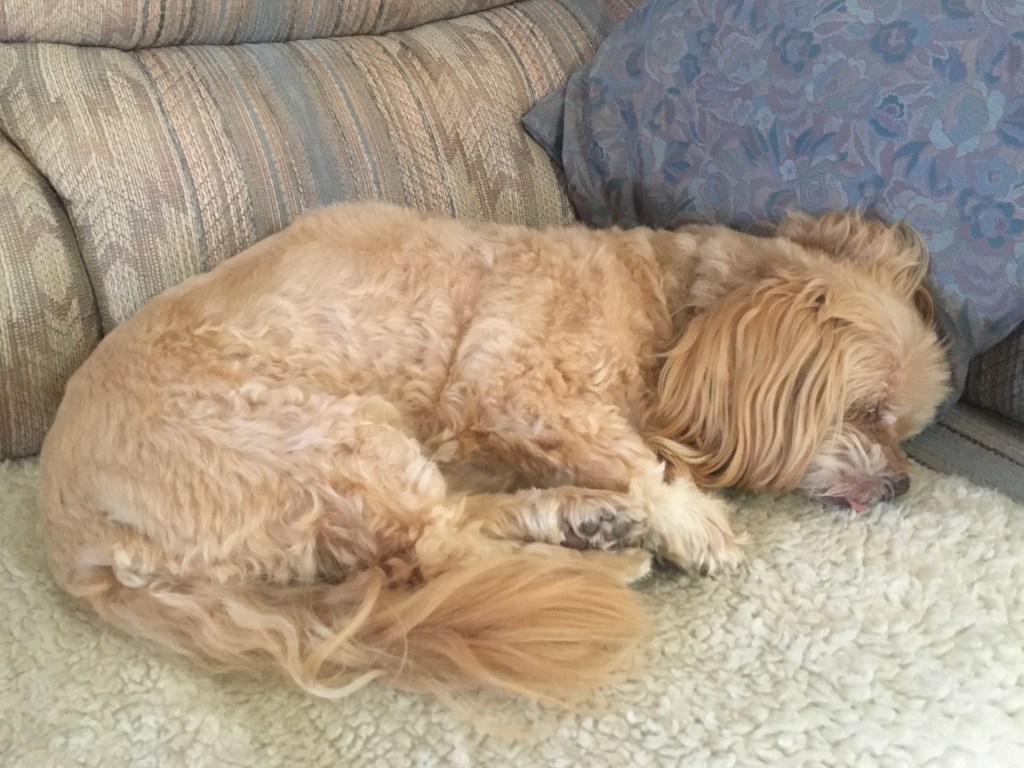
Sophie, my muse.

Sophie’s preferred spot for her old bones is on the sofa or loveseat. As soon as I move to the livingroom table, where I can spread papers out in the brighter light (my study is dark), she’s right here staring at me, waiting to be lifted to comfort.

So here’s my sleeping muse—on her job of keeping me working by her presence alone. 

Vacation Snippets

In Amsterdam, we took a canal tour. It was fun, scenic* and informational. We learned that the number of bikes in the city exceeds that of its population—single speed bikes that whiz along the flat land. We saw far more parked bikes than cars. 

In the U.S. we have more guns than people. Which do you suppose is the healthier way to live?

*I might have included a photo here but don’t yet know how to get pictures off my camera and into my laptop. The sunrise below was taken on my phone.

Sleep

Jet lag. Did my best to stay awake that last leg of flying home, after lying awake in a hotel room for hours the night before. Other than a brief doze on the plane around noon—I wonder what time that would have been in Amsterdam?—I succeeded in staying awake during the sun-lit day hours.

Once home, an (unplanned) trick kept me up and moving even after sleepiness hit. Since I’d deposited everything on my bed. I couldn’t get in it until that mess was sorted.

Success! I achieved six solid hours of real sleep, from 8:30 pm till 2:30 am. 

And then nothing.

Oh, but my intention for months has been to get up earlier. By 8:30 am, I had accomplished a great deal: scribbling notes, physical therapy**, eating breakfast and newspaper puzzles, feeding and walking Sophie, starting the first wash, grocery shopping . . .

The next day, I was wide awake and up at 3:30. Though a bit draggier than the day before. And this morning managed to rise at 4:30. Perfect.

**If I get up before the newspaper arrives, I can do PT expeditiously, without the procrastination and diversion of puzzling over puzzles. 

The Cruise.

I still wish it had been a smaller boat. I had visions—fed by my long-ago Atlantic crossing as an exchange student—of standing on the prow breathing fresh air while we cruised up and down the Norwegian fjords. Instead, often that cruising happened at night. And there was only one very crowded high deck to look out from.

But the break from routine was long overdue. I’m back to revision with a fresh eye.

How about you? What kind of breaks do you prefer?

Deadlines and Emotional Support

One of the hardest things about taking a trip is leaving Sophie behind.

I think of her as my Security Animal, but what does that mean? It’s not that she makes me feel secure—in the danger sense. She’s deaf to all but the loudest noises (so thunder is no problem any more). She doesn’t see well—though if a cat runs in front of her she will react. Last week she was barking and I let her out. She continued haranguing that now invisible creature—probably a cat. It was good to see her lively and aroused, her tail held like a banner. But no, she probably would not react if someone broke into the house.

So what is Security anyway? To me it comes down to a sense of belonging, of having a purpose. Sophie’s purpose is to belong to me the same way she belonged to Wayne, when he fed her and made her appointments. My purpose is to care for her for as long as she lives—and miss her afterwards. I love her for who she is and she reciprocates.

So the best security creature, or Emotional Support Animal, is a two-way street of loving and giving.  it’s a good thing she also loves Jane who will be taking care of her. But Jane always tells me she starts watching for my return long before I’m due back.

Deadlines

I love deadlines—and oh, how I resist them. I’ve watched myself, over the years, escaping from that inevitable noose until not quite the last minute.

In this case, I’ve imposed any number of deadlines on myself, all coming due when I leave home for twelve days. There’s the trip itself, the house-sitter instructions, preparing a manuscript for beta readers, packing and worrying about forgetting something, packing Sophie up for a visit to her other home and worrying about forgetting her things . . .

And here I am, amazed at how efficient I’ve been on these last two days. Almost every move has had a purpose. It makes clear how unpurposeful most of my days are.

They say if you want something done, ask a busy person. Well, maybe . . . But I definitely have not been writing. So what is there to measure?

I do hope to return with renewed purpose and vigor. This efficiency simply proves that I’m really leaving home—and I need the break! But it’s hard to leave Sophie behind.

A recent sunrise

Shaking Loose—

Last night I noted in my journal that I was going to miss another blog deadline. I had been doing so well at making weekly entries and then . . .

And then—besides paying a visit to my daughter—my head got tied up with the current opus revisions. Any spare blog thoughts kept flying away before they could be captured. My writer’s brain had taken charge.

Anne Morrow Lindbergh’s journals left a lasting impression on me. I must have been reading library copies back in the late seventies or early eighties. My most vivid memory is her description of moving to Hawaii and setting up household—how important it was that she get everything settled the way she wanted it—before she returned to writing. 

Since I don’t have her words, I’m going to rephrase them the way I understand it. Once AML was back in her writing headspace, she would no longer be aware of her physical surroundings. How true that is! Besides feeding Sophie and myself, keeping the dishes washed (and occasionally the clothes), I fail to see a lot of what surrounds me.

With a trip coming up, and my self-imposed deadline looming, it seemed a good idea to hire people to come clean my house—which drove me out of it to wipe down my very dusty car. And while doing that, my blog brain clicked in. Unable to get back to revisions with the house getting turned upside down is one way of clearing one’s head.

I’m seeing other advantages to having cleaners. Preparations required tucking away—or tossing—clutter. I took donations to my favorite thrift store. Downsizing was begun about a year ago, but that came to a halt (due to writer’s brain). So perhaps having a monthly cleaner might help shake loose a few brain cells to continue downsizing. 

As for the coming trip—Wayne and I used to go camping and hiking every summer. It gave me time to break free from work thoughts and play with writing thoughts.— This time, while away, I’m hoping to get a handle on an unfinished fairytale retelling, the very first one I tried writing in verse. 

Much as I love my Viking heroine, the main character appears to be a Pookah. (Yes, I know Pookahs are British and the action takes place in Norway). Since I’m no trickster myself, I don’t know if I can pull it off.

But every vacation needs a challenge. Right?

A recent sunset